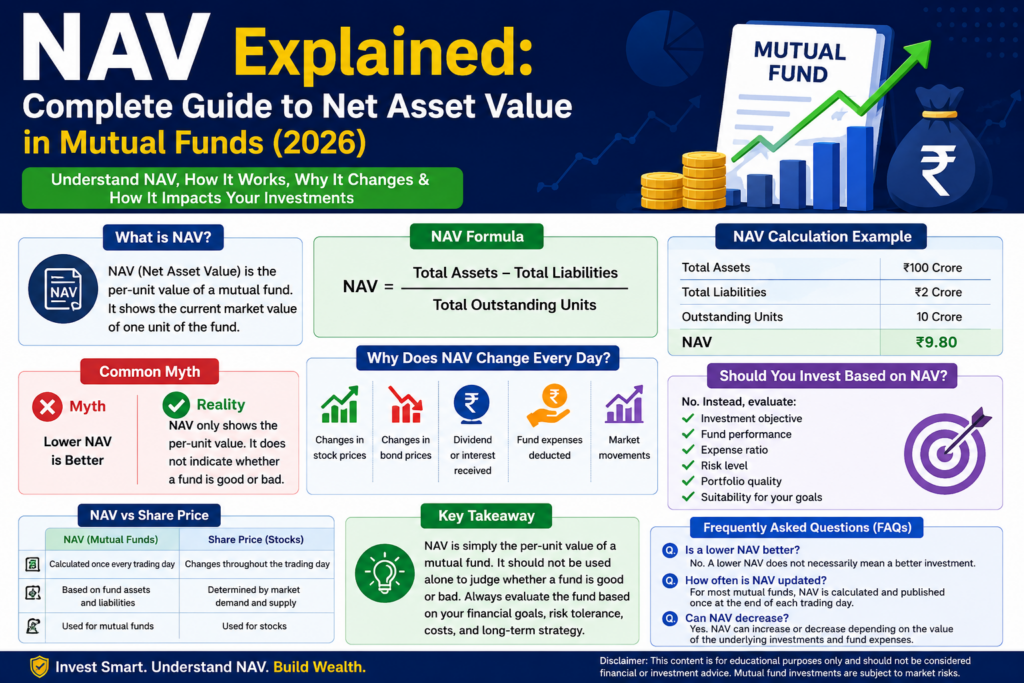
📈 NAV Explained: Complete Guide to Net Asset Value in Mutual Funds (2026)
One of the first terms every mutual fund investor comes across is NAV (Net Asset Value). Many beginners mistakenly believe that a lower NAV means a cheaper or better mutual fund. However, this is a common misconception.
In this complete 2026 guide, you’ll learn what NAV is, how it is calculated, why it changes daily, and whether it should influence your investment decisions.
📖 Read Complete Guide
What is NAV?
NAV (Net Asset Value) is the per-unit value of a mutual fund. It represents the value of one unit after deducting all liabilities from the total assets of the fund.
How is NAV Calculated?
The NAV is calculated at the end of every trading day using the following formula:
NAV = (Total Assets − Total Liabilities) ÷ Total Outstanding Units
NAV Calculation Example
| Particulars | Amount |
|---|---|
| Total Assets | ₹100 Crore |
| Total Liabilities | ₹2 Crore |
| Outstanding Units | 10 Crore Units |
| NAV | ₹9.80 |
Why Does NAV Change Every Day?
- 📈 Changes in stock prices.
- 📉 Changes in bond prices.
- 💰 Dividend or interest received.
- 💸 Fund expenses deducted.
- 📊 Market movements.
Common Myth: Lower NAV is Better
Myth: A fund with an NAV of ₹20 is cheaper than a fund with an NAV of ₹200.
Reality: NAV only represents the per-unit value. It does not indicate whether a mutual fund is expensive, cheap, better, or worse. Fund performance depends on portfolio quality, investment strategy, costs, and market performance—not simply the NAV.
NAV vs Share Price
| NAV | Share Price |
|---|---|
| Calculated once every trading day. | Changes throughout the trading day. |
| Based on fund assets and liabilities. | Determined by market demand and supply. |
| Used for mutual funds. | Used for stocks. |
Should You Invest Based on NAV?
No. Instead of focusing only on NAV, evaluate:
- ✅ Investment objective
- ✅ Fund performance over different market cycles
- ✅ Expense Ratio
- ✅ Risk level
- ✅ Fund manager’s track record
- ✅ Portfolio quality
Common Mistakes to Avoid
- ❌ Buying a fund only because its NAV is low.
- ❌ Comparing NAV across different mutual funds.
- ❌ Ignoring investment goals and risk profile.
- ❌ Focusing on price instead of overall portfolio quality.
Frequently Asked Questions (FAQs)
Q1. Is a lower NAV better?
No. A lower NAV does not necessarily mean a better investment. It simply reflects the per-unit value of the fund.
Q2. How often is NAV updated?
For most mutual funds, NAV is calculated and published once at the end of each trading day.
Q3. Can NAV decrease?
Yes. NAV can increase or decrease depending on the value of the underlying investments and fund expenses.
Q4. Should NAV be the only factor while selecting a mutual fund?
No. Investors should consider investment objectives, risk, historical performance, expense ratio, and suitability for their financial goals.
Key Takeaway
NAV is simply the per-unit value of a mutual fund. It should not be used alone to judge whether a fund is good or bad. Always evaluate the fund based on your financial goals, risk tolerance, costs, and long-term investment strategy.
Disclaimer: This article is for educational purposes only and should not be considered financial or investment advice. Mutual fund investments are subject to market risks. Please read all scheme-related documents carefully before investing and consult a qualified financial advisor before making investment decisions.