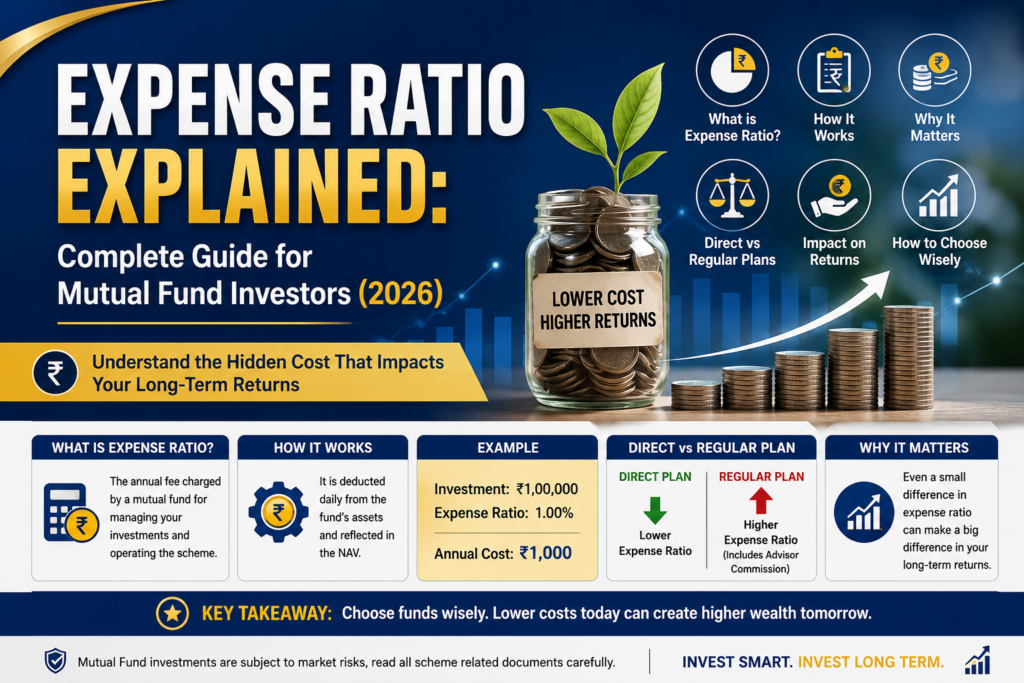
💰 Expense Ratio Explained: Complete Guide for Mutual Fund Investors (2026)
The Expense Ratio is one of the most important factors to consider before investing in a mutual fund. Even a small difference in expense ratio can significantly impact your long-term investment returns due to the power of compounding.
In this complete 2026 guide, you’ll learn what the expense ratio is, how it works, how it affects your returns, and how to choose mutual funds wisely.
📖 Read Complete Guide
What is an Expense Ratio?
The Expense Ratio is the annual fee charged by a Mutual Fund to manage your investments. It covers expenses such as fund management, administration, marketing, registrar fees, and other operating costs.
It is expressed as a percentage of the fund’s average assets under management (AUM) and is deducted from the fund’s NAV automatically.
How Does Expense Ratio Work?
Suppose a mutual fund has an Expense Ratio of 1%. This means the fund deducts approximately 1% annually from its assets to cover operational expenses. Investors do not pay this separately—the cost is reflected in the NAV.
Expense Ratio Example
| Investment | Expense Ratio | Annual Cost |
|---|---|---|
| ₹1,00,000 | 1.00% | ₹1,000 |
| ₹5,00,000 | 0.75% | ₹3,750 |
| ₹10,00,000 | 1.50% | ₹15,000 |
What Does the Expense Ratio Cover?
- ✅ Fund management fees
- ✅ Administrative expenses
- ✅ Registrar and transfer agent charges
- ✅ Custodian fees
- ✅ Marketing and distribution expenses (Regular Plans)
- ✅ Audit and compliance costs
Direct vs Regular Plan Expense Ratio
| Feature | Direct Plan | Regular Plan |
|---|---|---|
| Expense Ratio | Generally Lower | Generally Higher |
| Distributor Commission | Not Included | Included |
| Professional Guidance | No | Yes |
Why is Expense Ratio Important?
- ✔ Directly impacts long-term returns.
- ✔ Lower costs leave more of your investment working for you.
- ✔ Important when comparing similar mutual funds.
- ✔ Particularly relevant for long-term investors.
Common Mistakes to Avoid
- ❌ Choosing a fund only because it has the lowest expense ratio.
- ❌ Ignoring the fund’s performance and investment strategy.
- ❌ Comparing different categories of mutual funds.
- ❌ Ignoring the value of professional advice when needed.
Frequently Asked Questions (FAQs)
Q1. Is a lower expense ratio always better?
Not necessarily. A lower expense ratio is beneficial, but investors should also evaluate the fund’s objectives, performance, risk, and suitability.
Q2. Do I pay the expense ratio separately?
No. It is deducted by the fund house and reflected in the Net Asset Value (NAV).
Q3. Why do Regular Plans have higher expense ratios?
Regular Plans include distributor commissions and advisory support, which increase the overall cost.
Q4. Can expense ratio change?
Yes. Asset Management Companies (AMCs) may revise the expense ratio within applicable regulatory limits.
Key Takeaway
Expense Ratio is an important cost of mutual fund investing. Compare funds carefully, consider both cost and quality, and choose investments that match your financial goals and risk profile.
Disclaimer: This article is for educational purposes only and should not be considered financial or investment advice. Mutual fund investments are subject to market risks. Please read all scheme-related documents carefully before investing and consult a qualified financial advisor before making investment decisions.