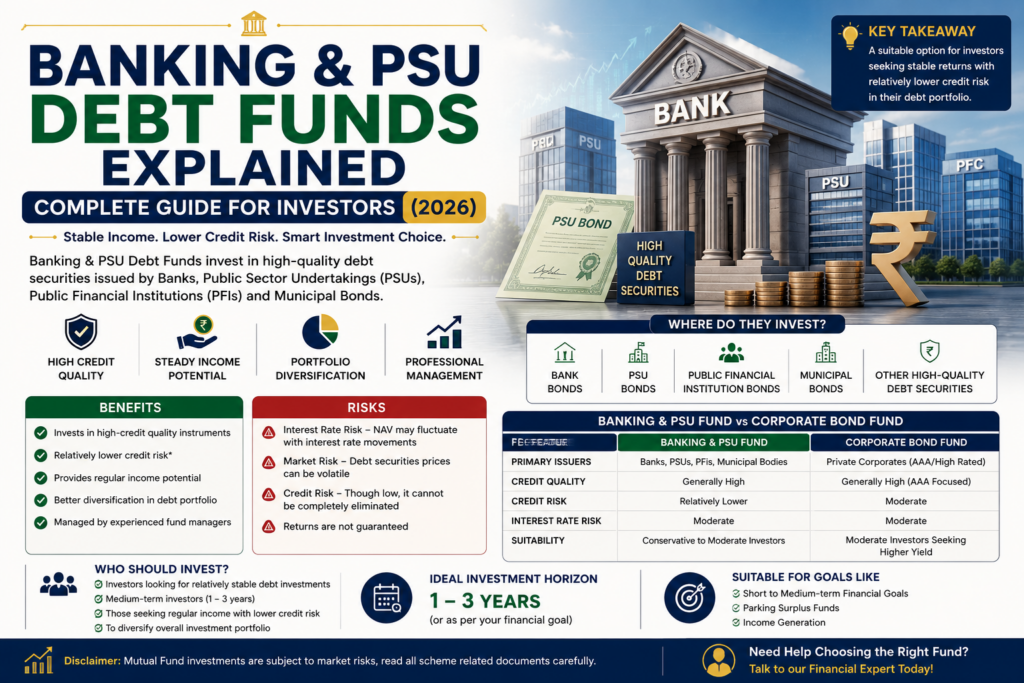
🏦 Banking & PSU Debt Funds Explained: Complete Guide for Investors (2026)
Banking & PSU Debt Funds are a category of Debt Mutual Funds that primarily invest in debt securities issued by banks, Public Sector Undertakings (PSUs), Public Financial Institutions (PFIs), and Municipal Bonds. These funds generally focus on high-credit-quality instruments and are considered suitable for investors seeking relatively stable fixed-income investments.
In this complete 2026 guide, you’ll learn how Banking & PSU Debt Funds work, their benefits, risks, taxation, and whether they are suitable for your investment goals.
📖 Read Complete Guide
1. What is a Banking & PSU Debt Fund?
A Banking & PSU Debt Fund is a Debt Mutual Fund that invests predominantly in debt instruments issued by banks, Public Sector Undertakings (PSUs), Public Financial Institutions (PFIs), and similar entities. These funds generally maintain high credit quality while offering fixed-income exposure.
2. Where Do Banking & PSU Debt Funds Invest?
- 🏦 Bank Bonds
- 🏛 PSU Bonds
- 📄 Public Financial Institution Bonds
- 🏙 Municipal Bonds
- 💼 High-Quality Debt Securities
3. Benefits of Banking & PSU Debt Funds
| Benefit | Description |
|---|---|
| High Credit Quality | Primarily invests in highly rated debt instruments. |
| Professional Management | Managed by experienced debt fund managers. |
| Portfolio Diversification | Provides diversified fixed-income exposure. |
| Income Potential | Aims to generate income through interest-bearing securities. |
4. Risks of Banking & PSU Debt Funds
- ⚠ Interest Rate Risk.
- ⚠ Market Risk.
- ⚠ Credit Risk (generally lower due to high-quality issuers).
- ⚠ Returns are not guaranteed.
5. Banking & PSU Debt Fund vs Corporate Bond Fund
| Feature | Banking & PSU Fund | Corporate Bond Fund |
|---|---|---|
| Primary Issuers | Banks & PSUs | Private Companies |
| Credit Quality | Generally High | Generally High (AAA focus) |
| Interest Rate Risk | Moderate | Moderate |
6. Who Should Invest?
- ✅ Investors seeking relatively stable debt investments.
- ✅ Medium-term investors.
- ✅ Investors looking for fixed-income portfolio diversification.
- ✅ Conservative to moderate risk investors.
7. Common Mistakes to Avoid
- ❌ Assuming debt funds are risk-free.
- ❌ Ignoring interest-rate risk.
- ❌ Investing without considering your investment horizon.
- ❌ Selecting funds based only on recent returns.
Frequently Asked Questions (FAQs)
Q1. Are Banking & PSU Debt Funds safe?
They generally invest in high-quality debt issued by banks and public sector entities, but they remain subject to market and interest-rate risks.
Q2. Can I invest through SIP?
Yes. Most Banking & PSU Debt Funds offer SIP investment options.
Q3. Are returns guaranteed?
No. Returns are market-linked and not guaranteed.
Q4. Are these funds better than Fixed Deposits?
They serve different purposes. Compare your liquidity needs, risk tolerance, and financial goals before investing.
Key Takeaway
Banking & PSU Debt Funds primarily invest in high-quality debt securities issued by banks and public sector institutions. They may be suitable for investors seeking professionally managed fixed-income exposure with relatively lower credit risk.
Final Thoughts
Banking & PSU Debt Funds can be a valuable part of a diversified investment portfolio. Before investing, evaluate your financial goals, investment horizon, and risk tolerance to determine whether they fit your needs.
Disclaimer: This article is for educational purposes only and should not be considered financial, tax, or investment advice. Mutual Fund investments are subject to market risks. Please read all scheme-related documents carefully before investing.