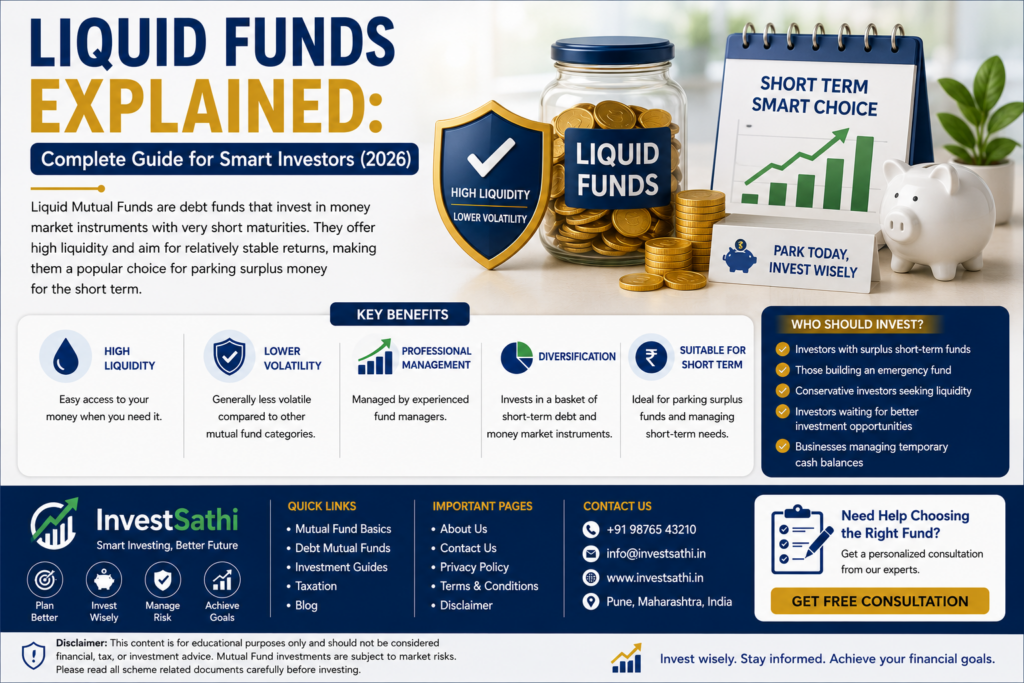
💧 Liquid Funds Explained: Complete Guide for Smart Investors (2026)
Liquid Mutual Funds are one of the most popular debt mutual fund categories for investors looking to park surplus money for a short period. They primarily invest in money market instruments with very short maturities, making them a commonly considered option for liquidity and relatively lower volatility compared to many other mutual fund categories.
In this complete guide, you’ll learn how Liquid Funds work, their benefits, risks, taxation overview, who should invest, and how they compare with Savings Accounts and Fixed Deposits.
📖 Read Complete Guide
1. What is a Liquid Fund?
A Liquid Mutual Fund is a type of Debt Mutual Fund that invests primarily in money market and debt instruments with very short maturities. These funds are designed to provide liquidity while aiming for relatively stable returns, although returns are market-linked and not guaranteed.
2. Where Do Liquid Funds Invest?
- 🏦 Treasury Bills (T-Bills)
- 💳 Commercial Papers (CP)
- 🏛 Certificates of Deposit (CD)
- 📄 Money Market Instruments
- 💼 Short-term Government Securities
3. Benefits of Liquid Funds
| Benefit | Description |
|---|---|
| High Liquidity | Suitable for short-term parking of funds. |
| Lower Volatility | Generally less volatile than equity funds. |
| Professional Management | Managed by experienced fund managers. |
| Portfolio Diversification | Exposure to multiple short-term debt instruments. |
4. Risks of Liquid Funds
- ⚠ Interest Rate Risk.
- ⚠ Credit Risk (depends on portfolio quality).
- ⚠ Returns are not guaranteed.
- ⚠ Inflation may reduce real returns.
- ⚠ Market-related risks still exist.
5. Liquid Fund vs Savings Account vs Fixed Deposit
| Feature | Liquid Fund | Savings Account | Fixed Deposit |
|---|---|---|---|
| Liquidity | High | Very High | Limited before maturity |
| Returns | Market-linked | Bank Interest | Fixed |
| Risk | Low (not risk-free) | Very Low | Generally Low |
6. Who Should Invest?
- ✅ Investors with surplus short-term funds.
- ✅ Individuals building an emergency fund.
- ✅ Conservative investors seeking liquidity.
- ✅ Investors waiting for future investment opportunities.
7. Common Mistakes to Avoid
- ❌ Assuming Liquid Funds are completely risk-free.
- ❌ Investing without understanding the investment objective.
- ❌ Ignoring taxation rules.
- ❌ Chasing returns instead of safety and liquidity.
- ❌ Not matching the investment with your time horizon.
Frequently Asked Questions (FAQs)
Q1. Are Liquid Funds safe?
Liquid Funds generally have lower volatility than equity funds but are subject to market and credit risks.
Q2. Can I withdraw money anytime?
Most Liquid Funds provide high liquidity, subject to the scheme’s applicable redemption rules.
Q3. Can I invest through SIP?
Yes. Most Liquid Funds allow SIP investments.
Q4. Are returns guaranteed?
No. Liquid Fund returns are market-linked and not guaranteed.
Key Takeaway
Liquid Funds are designed for investors seeking a place to park short-term surplus money with relatively high liquidity. They may be suitable for emergency funds or temporary cash management, depending on your financial goals and risk tolerance.
Final Thoughts
Liquid Mutual Funds can be a useful component of a diversified financial plan. Before investing, review the fund’s investment objective, portfolio quality, and your own financial needs to ensure it aligns with your goals.
Disclaimer: This article is for educational purposes only and should not be considered financial, tax, or investment advice. Mutual Fund investments are subject to market risks. Please read all scheme-related documents carefully before investing.