💰 Debt Mutual Funds Explained: Complete Guide for Beginners (2026)
Debt Mutual Funds invest primarily in fixed-income securities such as Government Securities (G-Secs), Treasury Bills, Corporate Bonds, Commercial Papers, Certificates of Deposit, and other money market instruments. These funds are generally considered by investors seeking relatively lower volatility compared to equity mutual funds, although they are not risk-free.
In this complete 2026 guide, you’ll learn how Debt Mutual Funds work, their types, benefits, risks, taxation overview, and who should consider investing in them.
📖 Read Complete Guide
1. What is a Debt Mutual Fund?
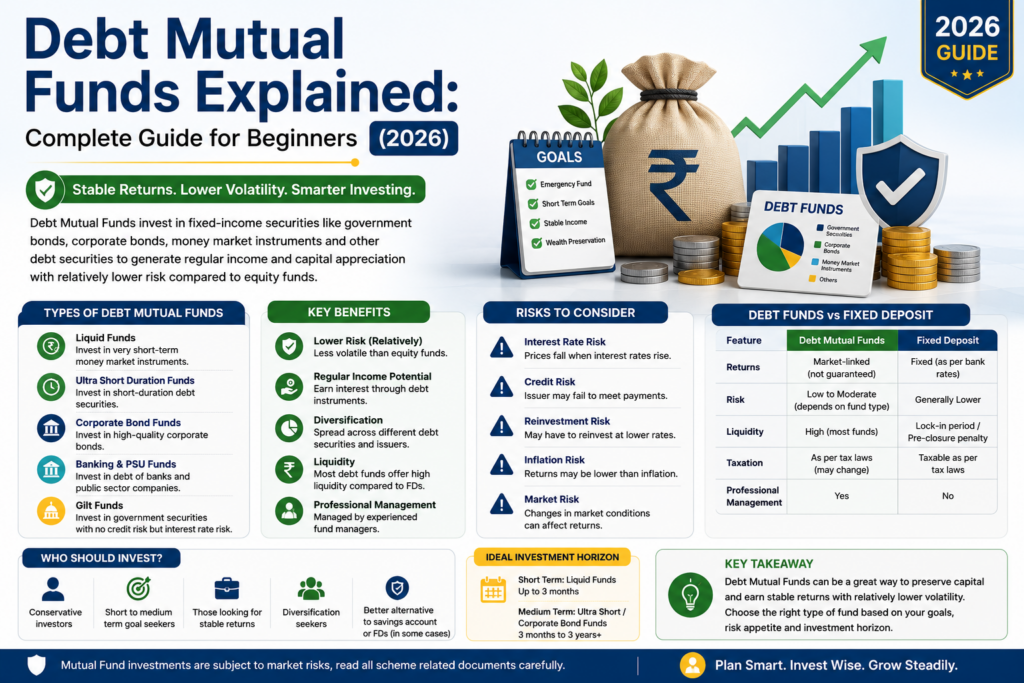
A Debt Mutual Fund pools money from investors and primarily invests in fixed-income instruments. The objective is generally to provide relatively stable returns by earning interest income and, in some cases, capital appreciation. The performance of these funds depends on factors such as interest rates, credit quality, and market conditions.
2. Types of Debt Mutual Funds
| Fund Type | Investment Focus |
|---|---|
| Liquid Fund | Very short-term money market instruments. |
| Ultra Short Duration Fund | Short-duration fixed-income securities. |
| Corporate Bond Fund | High-quality corporate debt securities. |
| Banking & PSU Fund | Debt issued by banks and public sector entities. |
| Gilt Fund | Government securities with no credit risk but interest-rate risk. |
3. Benefits of Debt Mutual Funds
- ✅ Lower volatility than equity funds (generally).
- ✅ Suitable for short- to medium-term financial goals.
- ✅ Professional portfolio management.
- ✅ Diversification across fixed-income instruments.
- ✅ Better liquidity than many traditional fixed-income investments.
4. Risks of Debt Mutual Funds
- ⚠ Interest Rate Risk.
- ⚠ Credit Risk.
- ⚠ Reinvestment Risk.
- ⚠ Inflation Risk.
- ⚠ Market Risk.
5. Who Should Invest?
- ✅ Conservative investors.
- ✅ Investors looking for lower volatility.
- ✅ Investors with short- or medium-term goals.
- ✅ Investors seeking portfolio diversification.
- ✅ Individuals looking for an alternative to traditional savings products.
6. Debt Funds vs Fixed Deposit
| Feature | Debt Mutual Fund | Fixed Deposit |
|---|---|---|
| Returns | Market-linked | Fixed (as per bank terms) |
| Liquidity | Generally High | May involve penalties on premature withdrawal |
| Risk | Low to Moderate (depends on fund type) | Generally Lower |
| Professional Management | Yes | No |
7. Taxation Overview (2026)
The taxation of Debt Mutual Funds depends on the prevailing tax laws at the time of investment and redemption. Tax rules may change over time, so investors should always verify the latest regulations or consult a qualified tax advisor before making investment decisions.
8. Common Mistakes to Avoid
- ❌ Assuming Debt Funds are completely risk-free.
- ❌ Ignoring credit quality.
- ❌ Selecting a fund without matching your investment horizon.
- ❌ Investing solely based on recent returns.
- ❌ Overlooking interest-rate risk.
Frequently Asked Questions (FAQs)
Q1. Are Debt Mutual Funds safe?
Debt Mutual Funds generally carry lower volatility than equity funds, but they are subject to interest-rate, credit, and market risks.
Q2. Can I invest through SIP?
Yes. Most Debt Mutual Funds allow SIP investments.
Q3. Are returns guaranteed?
No. Debt Mutual Fund returns are market-linked and not guaranteed.
Q4. Are Debt Funds suitable for emergency savings?
Some investors use certain categories such as Liquid Funds for short-term liquidity needs, depending on their financial objectives and risk tolerance.
Key Takeaway
Debt Mutual Funds can help diversify a portfolio and may be suitable for investors seeking relatively lower volatility than equity funds. Choosing the right category depends on your financial goals, investment horizon, and risk profile.
Final Thoughts
Debt Mutual Funds are an important part of a diversified investment strategy. Before investing, evaluate the fund’s objective, portfolio quality, risk factors, and your own financial needs to ensure it aligns with your investment plan.
Disclaimer: This article is for educational purposes only and should not be considered financial, tax, or investment advice. Mutual Fund investments are subject to market risks. Please read all scheme-related documents carefully before investing.