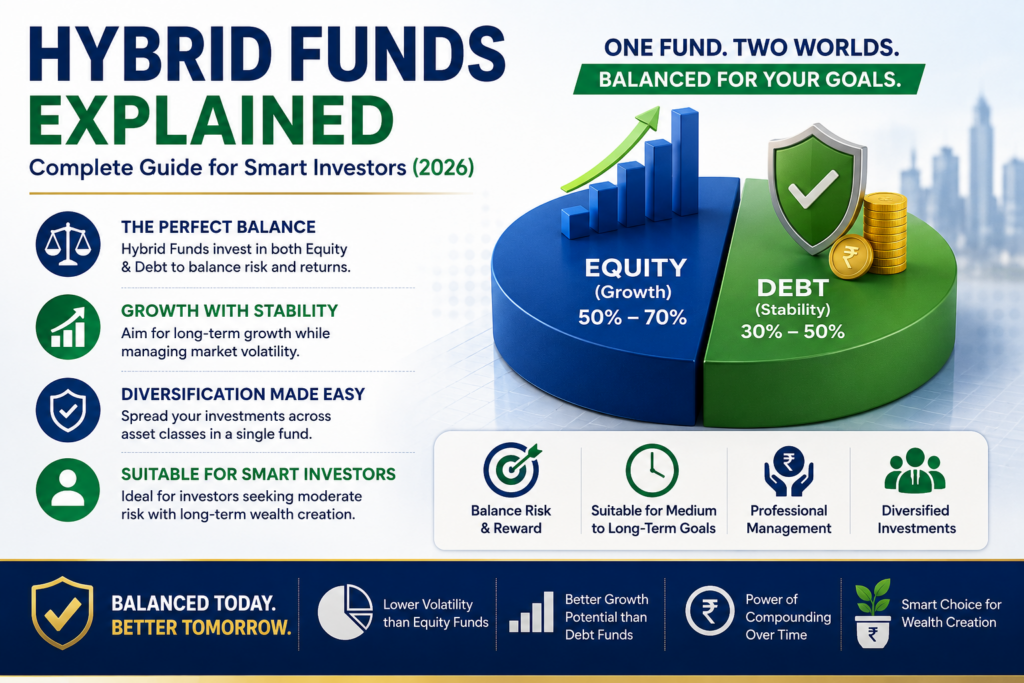
⚖️ Hybrid Funds Explained: Complete Guide for Smart Investors (2026)
Hybrid Funds are Mutual Funds that invest in a combination of Equity and Debt securities. Their objective is to balance growth potential with risk management by diversifying investments across different asset classes.
In this complete guide, you’ll learn how Hybrid Funds work, their types, benefits, risks, taxation basics, and who should consider investing in them.
📖 Read Complete Guide
1. What is a Hybrid Fund?
A Hybrid Fund is a Mutual Fund scheme that invests in a mix of Equity, Debt, and sometimes Gold or other asset classes. The aim is to reduce portfolio volatility while offering the opportunity for long-term capital appreciation.
2. How Do Hybrid Funds Work?
- ✅ Invest in both Equity and Debt instruments.
- ✅ Professional fund managers maintain the asset allocation.
- ✅ Portfolio is periodically rebalanced.
- ✅ Helps reduce overall investment risk through diversification.
- ✅ Suitable for investors seeking balanced growth.
3. Types of Hybrid Funds
| Type | Typical Allocation | Suitable For |
|---|---|---|
| Conservative Hybrid Fund | Higher Debt, Lower Equity | Conservative Investors |
| Balanced Hybrid Fund | Balanced Equity & Debt | Moderate Investors |
| Aggressive Hybrid Fund | Higher Equity, Lower Debt | Growth-Oriented Investors |
| Multi Asset Allocation Fund | Equity + Debt + Other Assets | Diversification Seekers |
| Dynamic Asset Allocation Fund | Allocation Changes with Market Conditions | Long-Term Investors |
4. Benefits of Hybrid Funds
- ✅ Diversification across asset classes.
- ✅ Potentially lower volatility than pure equity funds.
- ✅ Professionally managed asset allocation.
- ✅ Suitable for long-term wealth creation with balanced risk.
- ✅ Available through SIP and Lump Sum investment options.
5. Who Should Invest?
- 👨💼 First-time Mutual Fund investors.
- ⚖️ Investors with moderate risk tolerance.
- 📈 Long-term investors seeking balanced growth.
- 🎯 Investors looking for diversification in a single fund.
6. Risks to Consider
- ⚠ Equity market fluctuations can impact returns.
- ⚠ Debt investments may be affected by interest rate changes.
- ⚠ Returns depend on market performance and fund strategy.
- ⚠ No guaranteed returns.
7. Hybrid Funds vs Equity Funds vs Debt Funds
| Feature | Hybrid Fund | Equity Fund | Debt Fund |
|---|---|---|---|
| Risk | Moderate | Higher | Lower |
| Growth Potential | Balanced | Higher | Moderate |
| Suitable For | Balanced Investors | Aggressive Investors | Conservative Investors |
Common Mistakes to Avoid
- ❌ Assuming Hybrid Funds are risk-free.
- ❌ Choosing a fund without understanding its asset allocation.
- ❌ Investing only based on recent performance.
- ❌ Ignoring your financial goals and investment horizon.
- ❌ Frequently switching funds due to short-term market movements.
Frequently Asked Questions (FAQs)
Q1. Are Hybrid Funds suitable for beginners?
Yes. Many investors consider Hybrid Funds a suitable starting point because they provide exposure to multiple asset classes in a single fund.
Q2. Can I invest through SIP?
Yes. Hybrid Funds generally offer both SIP and Lump Sum investment options.
Q3. Are Hybrid Funds safer than Equity Funds?
Hybrid Funds may experience lower volatility than pure Equity Funds due to diversification, but they still carry market risks.
Q4. What is the ideal investment horizon?
A medium- to long-term investment horizon is generally suitable, depending on your financial goals and the type of Hybrid Fund.
Key Takeaway
Hybrid Funds combine Equity and Debt investments to provide a balanced approach to wealth creation and risk management. They can be a suitable choice for investors seeking diversification and moderate risk over the long term.
Final Thoughts
Hybrid Funds can help investors build a diversified portfolio through a single investment. Before investing, evaluate your financial goals, investment horizon, and risk profile to determine whether a Hybrid Fund aligns with your overall investment strategy.
Disclaimer: This article is for educational purposes only and should not be considered financial or investment advice. Mutual Fund investments are subject to market risks. Please read all scheme-related documents carefully before investing.