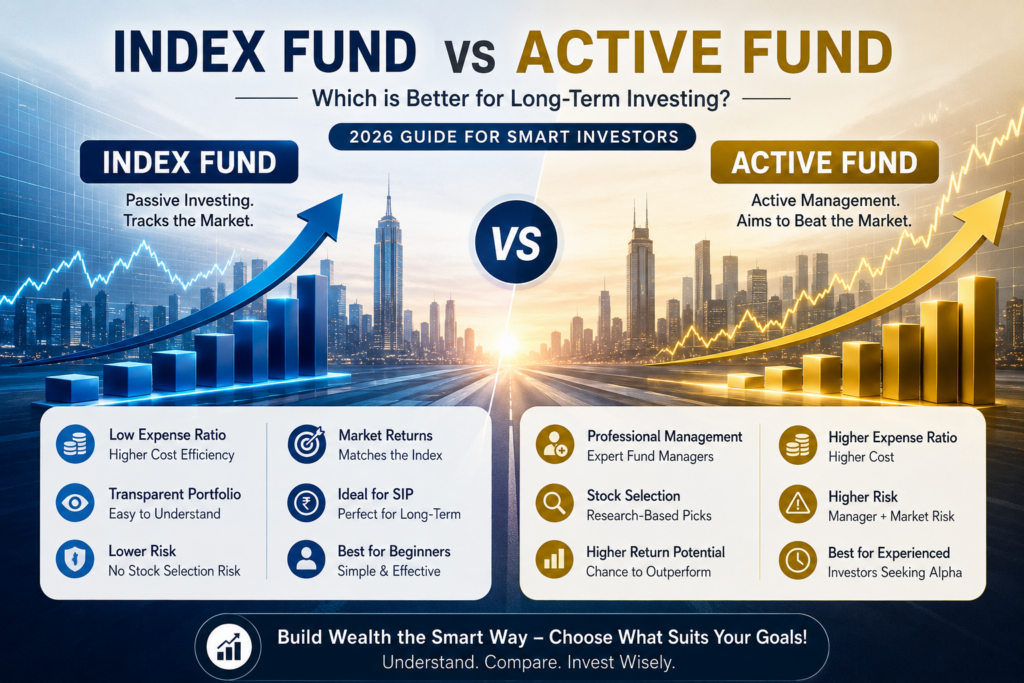
📈 Index Fund vs Active Fund: Which is Better for Long-Term Investing? (2026 Guide)
Choosing between an Index Fund and an Active Mutual Fund is one of the biggest decisions for investors. Both investment options aim to create wealth, but they follow different investment strategies, involve different costs, and deliver different outcomes.
In this complete guide, you’ll understand the difference between Index Funds and Active Funds, their advantages, disadvantages, and which one may be suitable for your financial goals.
📖 Read Complete Guide
1. What is an Index Fund?
An Index Fund is a passive Mutual Fund that tracks a market index such as the Nifty 50, Sensex, or Nifty Next 50. The fund manager simply replicates the index instead of selecting individual stocks.
- ✅ Passive Investment Strategy
- ✅ Lower Expense Ratio
- ✅ No Stock Selection Risk
- ✅ Suitable for Long-Term Investors
2. What is an Active Mutual Fund?
An Active Mutual Fund is managed by professional fund managers who actively select stocks with the objective of outperforming the market index.
- ✅ Professional Fund Management
- ✅ Research-Based Stock Selection
- ✅ Potential to Beat Benchmark
- ✅ Higher Expense Ratio
3. Index Fund vs Active Fund Comparison
| Feature | Index Fund | Active Fund |
|---|---|---|
| Investment Style | Passive | Active |
| Fund Manager Role | Tracks Index | Selects Stocks |
| Expense Ratio | Low | Higher |
| Return Potential | Matches Market | May Beat or Underperform Market |
| Risk | Market Risk | Market + Fund Manager Risk |
| Best For | Long-Term Passive Investors | Investors Seeking Alpha |
4. Advantages of Index Funds
- ✅ Low expense ratio improves long-term returns.
- ✅ Transparent portfolio.
- ✅ No dependence on fund manager performance.
- ✅ Ideal for SIP investing.
- ✅ Suitable for beginners and long-term investors.
5. Advantages of Active Funds
- ✅ Opportunity to outperform benchmark.
- ✅ Active portfolio management.
- ✅ Better flexibility during changing market conditions.
- ✅ Suitable for investors seeking higher growth potential.
- ✅ Access to expert research and stock selection.
6. Who Should Invest in Index Funds?
- 📈 Investors seeking stable long-term wealth creation.
- 💼 Beginners starting their investment journey.
- 💰 Investors who prefer lower investment costs.
- 📊 Investors who believe in market returns.
7. Who Should Invest in Active Funds?
- 🎯 Investors looking to beat market returns.
- 📊 Investors comfortable with slightly higher risk.
- 💼 Investors willing to rely on experienced fund managers.
- 📈 Investors investing for the long term.
Common Mistakes to Avoid
- ❌ Choosing funds only based on past returns.
- ❌ Ignoring expense ratio.
- ❌ Frequently switching between funds.
- ❌ Investing without financial goals.
- ❌ Expecting guaranteed returns.
Frequently Asked Questions (FAQs)
Q1. Which is better: Index Fund or Active Fund?
There is no universal answer. It depends on your investment objective, risk tolerance, and investment horizon.
Q2. Are Index Funds safer?
Index Funds eliminate fund manager risk but still carry market risk as they follow the market index.
Q3. Why are Index Funds cheaper?
Because they passively track an index and require less research and portfolio management.
Q4. Can Active Funds beat Index Funds?
Some Active Funds may outperform over certain periods, but many may not consistently beat their benchmark after expenses.
Key Takeaway
Index Funds offer low-cost passive investing, while Active Funds aim to outperform the market through expert fund management. The right choice depends on your financial goals, investment horizon, and risk appetite.
Final Thoughts
Both Index Funds and Active Mutual Funds can play an important role in your investment portfolio. Many experienced investors even combine both strategies to achieve diversification and long-term wealth creation. Selecting the right fund should always align with your financial goals and overall investment plan.
Disclaimer: This article is for educational purposes only and should not be considered investment advice. Mutual Fund investments are subject to market risks. Please read all scheme-related documents carefully before investing.
📋 Get Free Investment Consultation