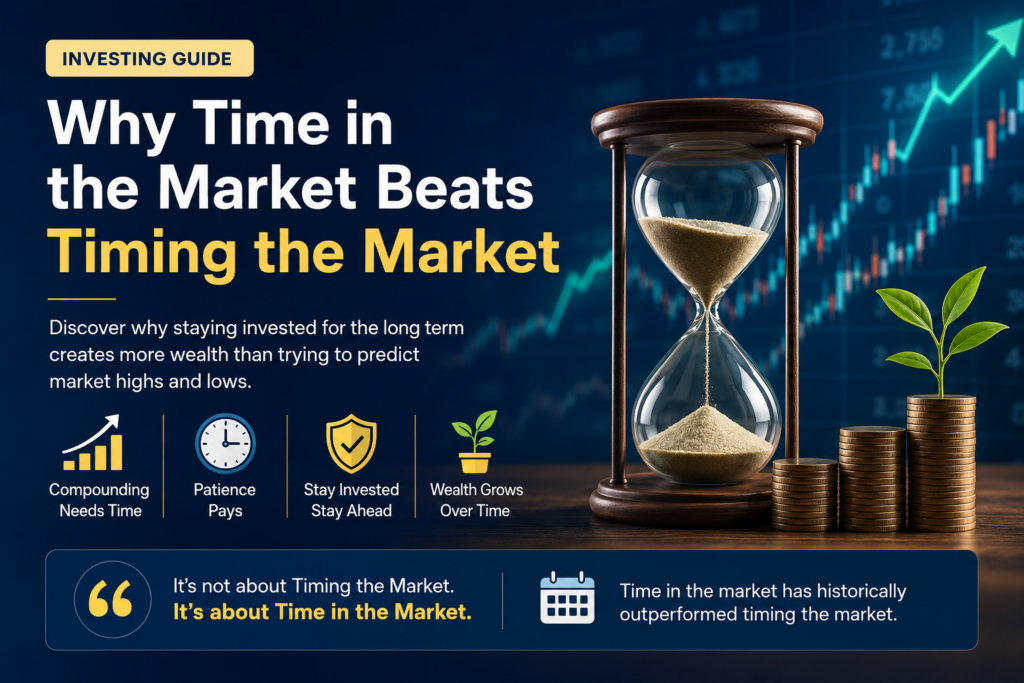
📈 Why Time in the Market Beats Timing the Market
Many investors spend years trying to predict the perfect time to buy or sell stocks. Unfortunately, consistently timing the market is extremely difficult—even for experienced professionals. History shows that staying invested for the long term has created more wealth than trying to predict every market movement.
Successful investing is less about finding the perfect entry point and more about allowing quality investments enough time to grow through the power of compounding.
📖 Read Complete Guide
1. What is Market Timing?
Market timing means trying to predict when prices will rise or fall so you can buy at the lowest point and sell at the highest point.
Although this sounds simple, no one can consistently predict market movements because prices react to thousands of economic, political, and global events.
- Waiting for the “perfect” buying opportunity
- Buying after news becomes positive
- Selling during panic
- Trying to avoid every market correction
2. What Does Time in the Market Mean?
Time in the market means staying invested through market ups and downs while allowing your investments to benefit from long-term business growth and compounding.
Rather than reacting to every market fluctuation, disciplined investors remain focused on their financial goals.
3. Why Staying Invested Creates More Wealth
✅ Compounding Works Only With Time
Compounding allows your investment returns to generate additional returns year after year. The longer your money remains invested, the greater the wealth creation potential.
✅ Markets Always Recover
Every major market correction in history has eventually been followed by recovery. Investors who stayed invested benefited from these recoveries.
✅ Missing Best Days Can Hurt Returns
Many of the stock market’s biggest gains happen shortly after major declines. Investors waiting for “the right time” often miss these powerful recovery rallies.
✅ Businesses Continue to Grow
Quality companies continue increasing their profits over many years. Long-term shareholders participate in this growth irrespective of short-term volatility.
4. Example
| Investor Waiting for Perfect Timing | Investor Staying Invested |
|---|---|
| Keeps waiting for market correction | Starts investing immediately |
| Misses several rallies | Benefits from every market recovery |
| Makes emotional decisions | Follows a disciplined strategy |
| Lower long-term returns | Higher probability of wealth creation |
5. Common Mistakes Investors Make
- ❌ Waiting forever for the perfect entry price.
- ❌ Selling during market panic.
- ❌ Buying after prices have already surged.
- ❌ Following social media investment tips.
- ❌ Ignoring long-term financial goals.
- ❌ Checking portfolio every day and reacting emotionally.
6. Best Practices for Long-Term Investors
- ✔ Invest regularly.
- ✔ Focus on quality businesses.
- ✔ Stay invested through market cycles.
- ✔ Review your portfolio periodically.
- ✔ Diversify across sectors and asset classes.
- ✔ Trust discipline more than predictions.
Key Takeaway
“It’s not about finding the perfect time to invest.
It’s about giving your investments enough time to grow.”
Final Thoughts
Nobody can consistently predict market highs and lows. Instead of chasing perfect timing, successful investors focus on building a diversified portfolio, staying disciplined, and allowing time to work in their favor.
Patience, consistency, and long-term thinking remain the most powerful wealth creation strategies.
Disclaimer: This article is intended for educational purposes only and should not be considered financial or investment advice. Investments in securities are subject to market risks. Please consult a qualified financial advisor before making investment decisions.