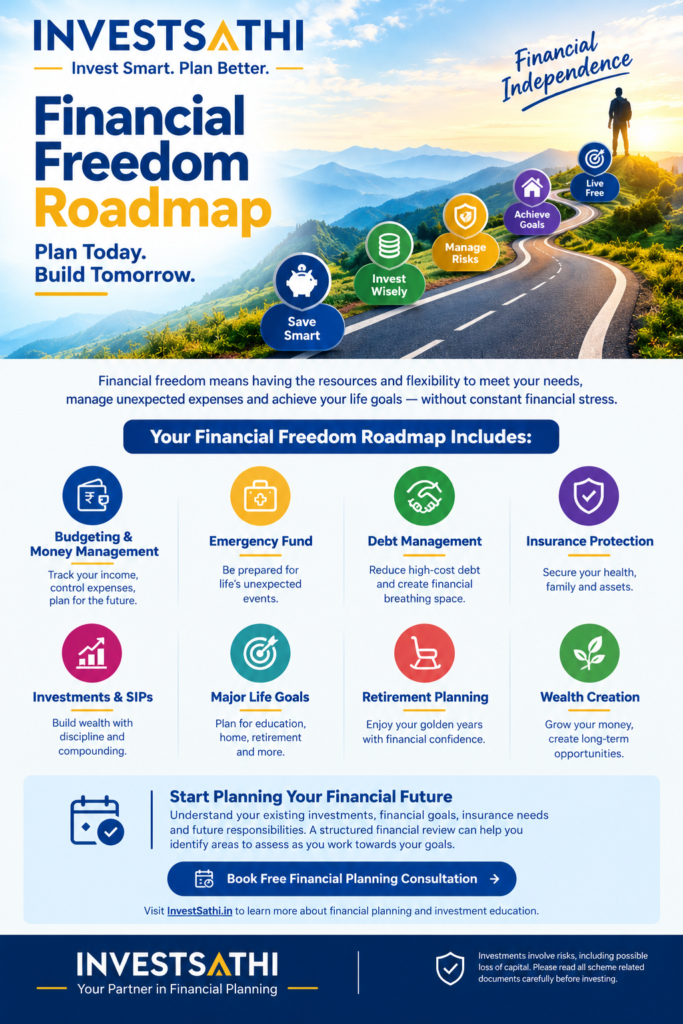
🗺️ Financial Freedom Roadmap: A Practical Guide to Financial Independence
Financial freedom means having the financial resources and flexibility to meet your needs, manage unexpected expenses and work towards your life goals without constant financial stress. It is not necessarily about becoming extremely wealthy. It is about building a financial system that supports your lifestyle, responsibilities and future aspirations.
Whether you are a salaried professional, business owner, young investor or planning for retirement, a structured financial freedom roadmap can help you organise your money, manage risks and make informed financial decisions. The journey begins with understanding your current financial position and creating a realistic plan for the future.
📚 Read the Complete Guide: Your Financial Freedom Roadmap
1. What Is Financial Freedom?
Financial freedom is the ability to manage your money in a way that supports your financial responsibilities and personal goals. It may include being debt-conscious, having emergency savings, maintaining suitable insurance and building investments for future needs.
For some people, financial freedom means buying a home without financial pressure. For others, it means funding their children’s education, becoming financially independent before retirement or having enough resources to make career and lifestyle choices.
Financial freedom is not just about how much you earn. It also depends on how much you save, how you manage debt, how you protect your family and how consistently you plan for the future.
2. Know Your Current Financial Position
Before creating a roadmap, understand where you stand financially. A clear financial picture helps you identify gaps and decide which priorities need attention first.
- Income: Calculate your salary, business income and other regular sources of earnings.
- Expenses: Track household spending, EMIs, bills and discretionary expenses.
- Assets: List savings, investments, property and other financial assets.
- Liabilities: Record outstanding loans, credit card balances and other obligations.
- Protection: Review health insurance, life insurance needs and emergency savings.
Your net worth is calculated by subtracting total liabilities from total assets. Reviewing it periodically can help you understand whether your overall financial position is improving.
3. Create a Monthly Money Management System
A financial plan becomes more practical when you know where your money goes every month. Instead of saving only what remains at the end of the month, consider allocating money towards important priorities as soon as income arrives.
Monthly take-home income: ₹80,000
Essential expenses: ₹35,000
Lifestyle and personal expenses: ₹15,000
Savings and investments: ₹20,000
Debt repayment or other financial goals: ₹10,000
Total allocation: ₹80,000
This is only an example, not a recommended allocation for everyone. Your budget should reflect your household responsibilities, debt, income stability and personal goals.
4. Build an Emergency Fund
Unexpected medical expenses, job changes, business interruptions or urgent repairs can disturb even a well-planned financial strategy. An emergency fund provides accessible money for such situations.
Many households use three to six months of essential expenses as an initial reference point. People with irregular business income, dependants or uncertain employment may need a different amount.
- Estimate your essential monthly expenses.
- Set a realistic emergency savings target.
- Keep the money accessible when needed.
- Replenish the fund after using it for a genuine emergency.
5. Manage Debt Before It Limits Your Future
Debt can reduce the amount of money available for saving and investing. High-interest credit card balances and expensive personal loans may be particularly challenging if they continue to grow.
List your outstanding loans, interest rates, EMIs and repayment dates. Consider prioritising high-interest debt while maintaining essential payments and an appropriate emergency reserve.
Borrowing should be evaluated according to affordability, the purpose of the loan, its cost and its impact on future financial goals. Avoid taking additional debt simply to maintain a lifestyle you cannot comfortably afford.
6. Protect Your Financial Future with Insurance
Financial planning is not complete without considering risks that could affect your family, income or savings. Insurance can help manage specified financial losses, subject to the policy’s terms and exclusions.
- Health Insurance: Helps cover eligible medical expenses according to the policy.
- Life Insurance: May provide financial protection to dependants if the insured person dies.
- Business Insurance: Can address selected business risks, depending on the cover.
- Asset Protection: Home, vehicle and other relevant insurance can help manage specified risks.
Choose coverage after reviewing your existing policies, dependants, liabilities and financial responsibilities. Insurance requirements vary from person to person.
7. Start Investing According to Your Financial Goals
Saving helps preserve money for future needs, while investing may help build wealth over time. The appropriate investment approach depends on your time horizon, risk tolerance, liquidity requirements and financial circumstances.
- Mutual Funds: Provide access to professionally managed investment portfolios, with risks depending on the fund.
- Stocks: Offer ownership in companies but can experience substantial price fluctuations.
- Fixed Deposits: Offer interest according to the product’s terms and applicable conditions.
- Bonds: May provide interest income but carry credit, interest-rate and liquidity risks.
- Exchange-Traded Funds (ETFs): Provide exposure to an index, asset or basket of securities according to their objectives.
- Retirement Investments: Suitable retirement-oriented products can be considered according to eligibility, tax treatment and individual needs.
No investment product is suitable for everyone. Diversification can help manage concentration risk, but it cannot eliminate losses. Avoid choosing investments only because of recent returns or claims of quick profits.
8. Use SIPs to Build an Investing Habit
A Systematic Investment Plan (SIP) allows you to invest a fixed amount regularly in a mutual fund. It can help create an investing routine that aligns with your monthly income.
For example, you might start with an affordable monthly contribution and review whether it can be increased as your income grows. The contribution should remain consistent with your emergency savings, debt obligations and other financial priorities.
A SIP is a method of investing, not a guarantee of returns. The value of a mutual fund investment can rise or fall, and your financial goal may not be achieved.
9. Plan for Major Life Goals
Financial freedom becomes easier to organise when your money is linked to specific goals instead of being invested without a clear purpose.
- Child Education: Estimate future education costs and start planning early.
- Home Purchase: Calculate the down payment, loan affordability and related expenses.
- Retirement: Estimate future living expenses, inflation and expected retirement income.
- Business Growth: Maintain suitable working capital while separating personal and business finances.
- Travel and Lifestyle: Create separate savings targets for planned discretionary spending.
Assign each goal a target amount and time horizon. This can help you decide how much to save and which investment risks may be appropriate for that goal.
10. Understand the Impact of Inflation
Inflation reduces the purchasing power of money over time. An amount that comfortably covers your expenses today may not cover the same expenses many years from now.
When planning for education, retirement or other long-term needs, consider how costs may change over time. Review your targets periodically rather than assuming that today’s expenses will remain unchanged.
Investment returns are uncertain, so avoid relying on a single projected return to determine whether your future goals are achievable.
11. Build a Retirement Roadmap
Retirement planning involves estimating how much money you may need when regular employment or business income reduces or stops.
- Estimate the age at which you want to retire.
- Calculate expected essential and lifestyle expenses.
- Consider inflation and healthcare costs.
- Review existing retirement savings and other assets.
- Account for possible pensions or other dependable income sources.
- Review your plan as your circumstances and assumptions change.
A retirement plan should consider both the accumulation phase, when you build assets, and the withdrawal phase, when you use those assets to support your expenses.
12. Avoid Common Financial Planning Mistakes
- Investing Without Goals: Understand the purpose and time horizon of each investment.
- Ignoring Emergency Savings: Avoid leaving yourself unprepared for unexpected expenses.
- Taking Excessive Risk: Do not invest money in unsuitable products simply to seek higher returns.
- Ignoring Insurance: Review potential financial risks to yourself and your dependants.
- Following Market Rumours: Base financial decisions on reliable information and your own circumstances.
- Delaying Planning: Start with manageable steps instead of waiting for the perfect time.
- Never Reviewing Your Portfolio: Reassess your investments when goals, finances or circumstances change.
13. Your 90-Day Financial Freedom Action Plan
Days 1–30: Understand
- Calculate your income, expenses, assets and liabilities.
- Review your existing insurance policies and investments.
- Identify your three most important financial goals.
Days 31–60: Organise
- Create a monthly budget.
- Set an emergency fund target.
- Prepare a debt repayment plan where needed.
- Estimate how much you can allocate to each goal.
Days 61–90: Take Action
- Set up a practical savings routine.
- Review suitable investment options based on your risk profile.
- Document your financial goals and target dates.
- Schedule regular reviews of your financial plan.
14. Review Your Financial Freedom Progress
Financial freedom is a continuing process rather than a one-time achievement. Review your financial position periodically and make adjustments when your income, expenses, responsibilities or goals change.
- Is your savings rate sustainable?
- Are you making progress towards your financial goals?
- Do you have adequate emergency savings?
- Are your debt levels manageable?
- Does your insurance reflect your current needs?
- Are your investments appropriate for your time horizon and risk tolerance?
- Are your future targets realistic after considering inflation?
Conclusion: Start Your Financial Freedom Journey Today
Financial freedom is built through informed decisions, consistent habits and a financial plan that reflects your own circumstances. You do not need to achieve every goal immediately. Begin by understanding your current position, addressing important risks, managing debt and creating a realistic savings and investment routine.
The objective is not simply to accumulate assets. It is to build a financial foundation that helps you manage responsibilities, prepare for the future and make life decisions with greater financial confidence.
💼 Start Planning Your Financial Future
Understand your existing investments, financial goals, insurance needs and future responsibilities. A structured financial review can help you identify areas to assess as you work towards your financial goals.
Visit InvestSathi.in to learn more about financial planning and investment education.
Disclaimer: This article is for educational and informational purposes only. It is not investment advice or a recommendation to buy, sell or hold any financial product or security. Investments involve risks, including possible loss of capital. Mutual funds and equity investments are subject to market risks. Fixed deposits, bonds and insurance products are subject to their respective terms, conditions and risks. Financial decisions should consider your goals, risk tolerance, investment horizon, liquidity requirements, taxation and applicable costs. Consult an appropriately qualified financial professional for guidance specific to your circumstances.