“`html
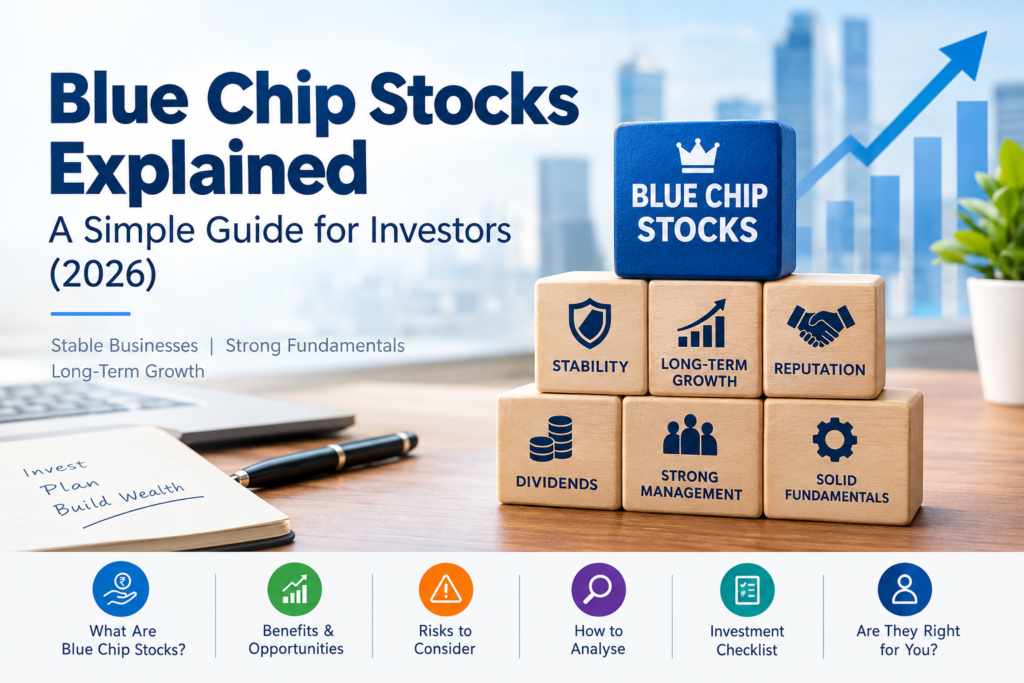
📘 Blue Chip Stocks Explained: A Simple Guide for Investors (2026)
Blue chip stocks are shares of well-established companies that generally have a strong market presence, established business models and a track record of operating through different market conditions. Investors often research these companies when building a long-term stock portfolio.
Understanding company fundamentals, financial performance, valuation, business risks and growth prospects can help investors evaluate whether a blue chip stock fits their financial goals, investment horizon and risk profile.
📚 Read the Complete Guide: Blue Chip Stocks Explained
1. What Are Blue Chip Stocks?
Blue chip stocks are shares of established companies that are generally recognised for their market presence, business reputation, established operations and financial track record.
These companies may operate in sectors such as banking, information technology, consumer goods, energy, healthcare and infrastructure.
2. What Are the Characteristics of Blue Chip Stocks?
- Established Business: The company generally has an established business model and operating history.
- Market Reputation: It may have a recognised brand and a significant presence in its industry.
- Financial Performance: Investors examine profitability, cash flows, debt and balance-sheet strength.
- Experienced Management: Corporate governance and management decisions are important factors.
- Market Liquidity: Many large established stocks have significant trading activity, although liquidity varies.
- Dividend History: Some blue chip companies pay dividends, but payments are not guaranteed.
3. Examples of Blue Chip Stocks in India
Investors researching established Indian companies may come across examples such as:
- Reliance Industries: Energy, retail and digital services.
- HDFC Bank: Banking and financial services.
- ICICI Bank: Banking and financial services.
- Infosys: Information technology services.
- Tata Consultancy Services (TCS): IT services and consulting.
- ITC: Consumer products and other businesses.
- Larsen & Toubro (L&T): Engineering and infrastructure.
These are illustrative examples, not a ranking or a recommendation to buy these stocks. Their financial performance, valuation and investment suitability can change over time.
4. How Do Blue Chip Stocks Work?
When you buy shares of a company, you acquire an ownership interest in that business. Your investment value changes with the market price of the shares.
Investors may potentially earn returns through capital appreciation and dividends, if declared by the company.
Suppose you purchase 10 shares at ₹1,000 per share.
Initial Investment = 10 × ₹1,000 = ₹10,000
If the share price rises to ₹1,200, the holding value becomes ₹12,000.
Unrealised Gain = ₹12,000 − ₹10,000 = ₹2,000, or 20%, before applicable costs and taxes.
If the share price falls, the value of your investment may decline.
5. Blue Chip Stocks vs Mid Cap vs Small Cap Stocks
| Feature | Blue Chip | Mid Cap | Small Cap |
|---|---|---|---|
| Business Profile | Generally established | Medium-sized company | Smaller listed company |
| Growth Potential | Depends on business prospects | Can offer growth opportunities | Can offer growth opportunities |
| Volatility | Can still be volatile | May experience higher volatility | May experience higher volatility |
| Risk | Market and company-specific risks | Market and business risks | Market, business and liquidity risks |
Blue chip is a market description rather than a formal market-cap classification. Not every large-cap stock necessarily meets every investor’s definition of a blue chip company.
6. Benefits of Blue Chip Stocks
- Established Companies: Investors can study a longer operating history.
- Potential Long-Term Growth: Shareholders may benefit if the company’s business and earnings grow.
- Potential Dividend Income: Some companies distribute dividends to eligible shareholders.
- Public Information: Financial statements and company disclosures can help investors conduct research.
- Portfolio Building: Blue chip stocks may form part of a diversified equity portfolio.
7. Risks of Investing in Blue Chip Stocks
Even established companies can face financial difficulties, competition, regulatory changes and declining demand.
- Market Risk: Share prices may fall during market corrections.
- Valuation Risk: An expensive stock may deliver disappointing returns even when the business remains strong.
- Business Risk: Competition and changing industry conditions can affect profits.
- Management Risk: Poor decisions or weak corporate governance may affect shareholder value.
- Concentration Risk: Holding only a few stocks can expose a portfolio to company-specific risks.
- Dividend Risk: Dividends may be reduced or discontinued.
8. How to Analyse a Blue Chip Stock
Investors can review the following factors when researching an individual company:
- Revenue Growth: Examine the company’s sales trends over time.
- Profit Growth: Review earnings and operating margins.
- Debt: Assess borrowing levels and interest obligations.
- Cash Flow: Understand how much cash the business generates.
- Return Ratios: Review ROE and ROCE in the context of the industry.
- Valuation: Examine P/E, P/B and other relevant measures against growth prospects and comparable companies.
- Corporate Governance: Review management quality and company disclosures.
- Industry Outlook: Understand competition and long-term business opportunities.
9. Blue Chip Stocks vs Index Funds
A blue chip stock represents ownership in an individual company, while an index fund seeks to track a particular market index by investing according to its methodology.
| Feature | Blue Chip Stock | Index Fund |
|---|---|---|
| Investment | Individual company shares | Tracks a specified index |
| Diversification | Depends on the number of holdings | Generally holds multiple index constituents |
| Research | Company-specific research | Index composition, costs and tracking |
| Risk | Company-specific and market risks | Market and index concentration risks |
Both approaches carry investment risks. The appropriate choice depends on the investor’s financial goals, risk tolerance, investment knowledge and overall portfolio.
10. Who May Consider Blue Chip Stocks?
Blue chip stocks may be considered by investors who understand equity-market risks and want exposure to established businesses as part of a long-term investment strategy.
Suitability depends on financial goals, investment horizon, liquidity requirements, risk profile, valuation and diversification. An established company’s shares may not be suitable for every investor.
11. Blue Chip Stock Investment Checklist
☑ Understand the company’s business model
☑ Review revenue and profit growth
☑ Check debt and cash flows
☑ Analyse company valuation
☑ Evaluate management and corporate governance
☑ Understand industry and market risks
☑ Avoid concentrating investments in a few stocks
☑ Consider financial goals and risk tolerance
☑ Review your portfolio periodically
12. Are Blue Chip Stocks Suitable for Long-Term Investors?
Blue chip stocks may play a role in a long-term equity portfolio, but holding a stock for many years does not guarantee a profit.
Investors should periodically review company fundamentals, valuation and portfolio allocation to determine whether their investments continue to align with their financial goals.
💼 Want to Review Your Investment Portfolio?
Get a structured review of your existing investments and understand how your portfolio aligns with your financial goals, investment horizon and risk profile.
Disclaimer: This content is for educational and informational purposes only and should not be construed as investment advice, a recommendation to buy or sell any security, or a guarantee of returns. Company examples are illustrative and are not investment recommendations. Equity investments are subject to market risks, including possible loss of capital. Investors should consider their financial goals, risk profile, investment horizon, liquidity requirements, diversification and applicable taxation before making investment decisions. Please consult an appropriately qualified financial professional for advice specific to your circumstances.
“`1px solid #ddd;”>Index, fund costs and tracking