“`html
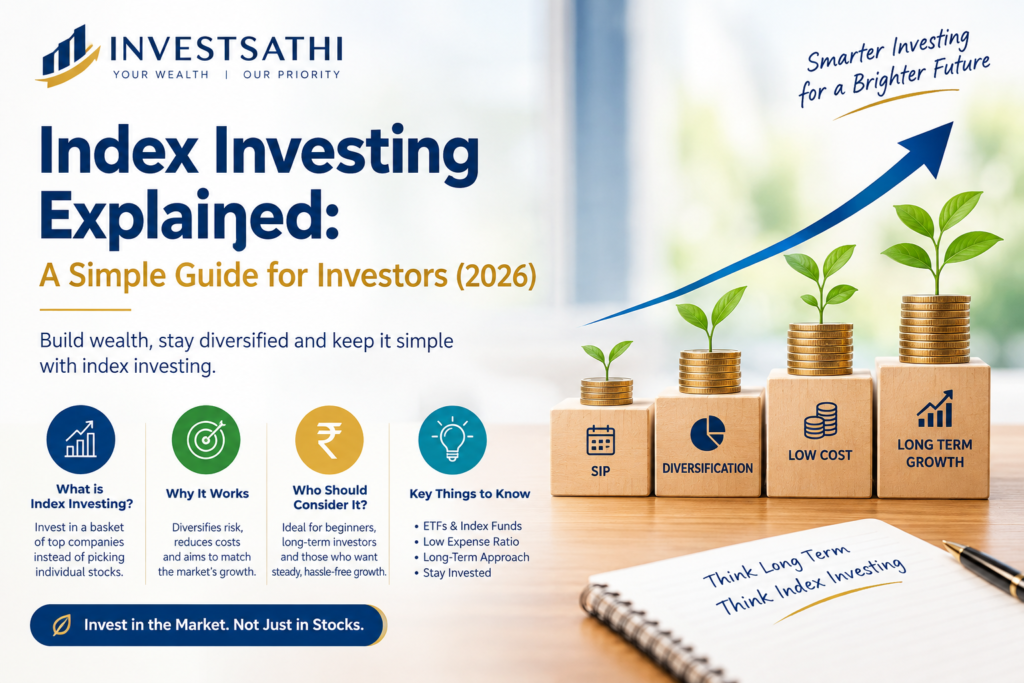
📈 Index Investing Explained: A Simple Guide for Investors (2026)
Index investing is an investment approach where investors aim to track the performance of a particular market index instead of trying to select individual stocks or actively outperform the market.
Index investing can be accessed through products such as index mutual funds and exchange-traded funds (ETFs). Understanding how these products work can help investors evaluate whether index investing fits their financial goals, investment horizon and risk profile.
📚 Read the Complete Guide: Index Investing Explained
1. What Is an Index?
A stock market index is a group of selected securities designed to represent a particular segment or portion of the market. An index tracks the performance of its constituent securities according to a defined methodology.
2. What Is Index Investing?
Index investing means investing in a fund or ETF that aims to replicate the performance of a specific market index.
For example, an index fund may seek to track a broad-market index by holding securities in proportions similar to the index methodology.
The objective is generally to provide returns that broadly correspond to the performance of the underlying index, before expenses and tracking differences.
3. How Does Index Investing Work?
An index fund or ETF typically invests in securities that form part of its underlying index. The fund follows the index methodology rather than relying primarily on a fund manager to select individual securities with the objective of outperforming the index.
If an index contains 50 companies, an index-tracking fund may hold those companies according to the weight assigned by the index methodology.
4. Index Funds vs Active Mutual Funds
| Feature | Index Fund | Active Fund |
|---|---|---|
| Approach | Tracks an index | Manager selects investments |
| Objective | Replicate index performance | Seek to outperform a benchmark |
| Portfolio Changes | Generally based on index changes | Based on investment decisions |
| Risk | Depends on the underlying index | Depends on the fund’s portfolio and strategy |
5. What Are the Benefits of Index Investing?
- Diversification: One index-tracking product can provide exposure to multiple securities.
- Simple Approach: Investors do not need to select every individual stock themselves.
- Transparent Strategy: The underlying index and its methodology are generally publicly available.
- Market Exposure: Investors can obtain exposure to a particular market segment through an index-tracking product.
- Cost Consideration: Passive funds may have lower operating expenses than some actively managed funds, although costs vary across products.
6. What Are the Risks of Index Investing?
Index investing does not eliminate investment risk. The value of an index fund or ETF can fall when the underlying securities decline in value.
- Market Risk: The investment value can rise or fall with the underlying market.
- Tracking Difference: Fund performance may differ from the index because of expenses, cash holdings, transaction costs and other factors.
- Concentration Risk: Some indices may have significant exposure to particular sectors or companies.
- Index-Specific Risk: The risk profile depends on the securities and methodology of the underlying index.
7. Index Mutual Funds vs ETFs
Both index mutual funds and ETFs can be designed to track an index, but they operate differently.
| Feature | Index Mutual Fund | ETF |
|---|---|---|
| Trading | Bought or redeemed through the mutual fund mechanism | Traded on a stock exchange |
| Price | Based on applicable NAV | Market price during exchange trading |
| Demat Account | Generally not required for direct mutual fund transactions | Generally required for exchange trading |
8. Who May Consider Index Investing?
Index investing may be considered by investors who want diversified exposure to a particular market index and prefer a passive investment approach.
The suitability of an index fund or ETF depends on factors such as the investor’s financial goals, time horizon, risk profile, liquidity requirements and overall asset allocation.
9. Is Index Investing Suitable for Long-Term Investors?
Index investing can be used as part of a long-term investment strategy. However, the appropriate index and investment product depend on the investor’s circumstances and the objective of the investment.
Investors should understand what an index represents before investing and periodically review whether the investment continues to align with their financial goals.
💼 Want to Understand Your Investment Portfolio?
Get a structured review of your existing investments and understand how your portfolio aligns with your financial goals, investment horizon and risk profile.
Disclaimer: This content is for educational and informational purposes only and should not be construed as investment advice, a recommendation, or a guarantee of returns. Gold prices can be volatile and may fall as well as rise. Investors should consider their financial goals, risk profile, investment horizon, liquidity requirements and applicable taxation before making investment decisions. Please consult a qualified financial professional for advice specific to your circumstances.