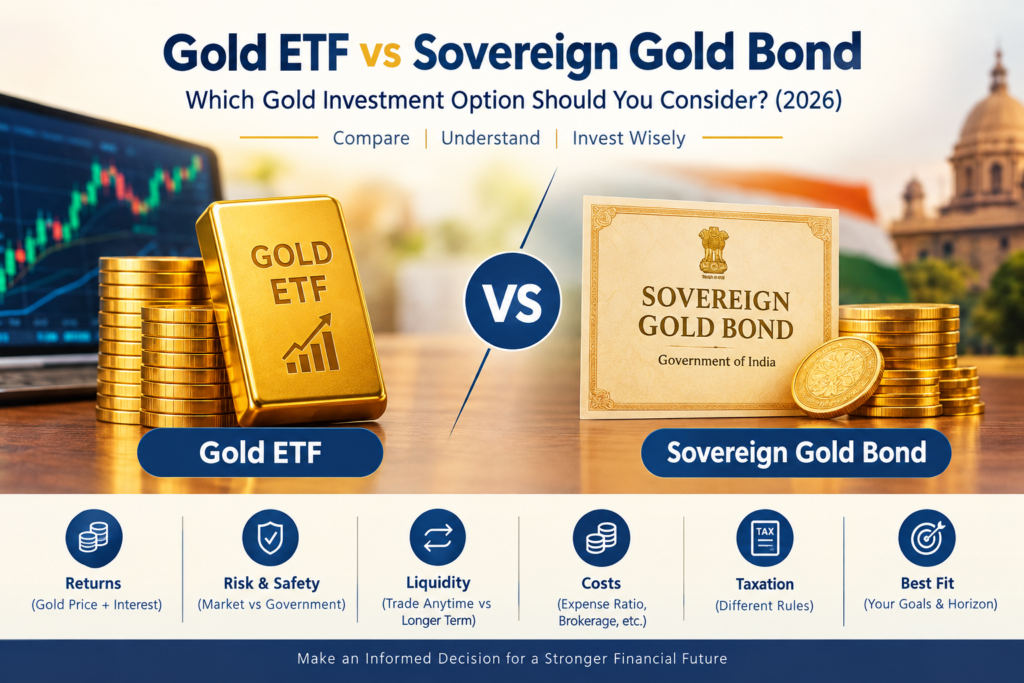
🪙 Gold ETF vs Sovereign Gold Bond: Which Gold Investment Option Should You Consider? (2026)
Gold has traditionally been considered an important asset for diversification and wealth preservation. Today, investors can gain exposure to gold through multiple options, including physical gold, Gold ETFs and Sovereign Gold Bonds (SGBs).
Among these options, Gold ETFs and Sovereign Gold Bonds have different structures, costs, liquidity features and tax considerations. Understanding these differences can help investors evaluate which option fits their financial goals, investment horizon and liquidity requirements.
📚 Read the Complete Guide: Gold ETF vs Sovereign Gold Bond
1. What Is a Gold ETF?
A Gold ETF (Exchange-Traded Fund) is a market-linked investment product designed to provide investors with exposure to the price of gold. Gold ETFs are traded on stock exchanges and can generally be bought or sold during market hours through a Demat and trading account.
Instead of storing physical gold at home, investors can obtain gold-price exposure through ETF units. The value of a Gold ETF generally moves in line with domestic gold prices, subject to expenses, tracking differences and market conditions.
2. What Is a Sovereign Gold Bond (SGB)?
A Sovereign Gold Bond (SGB) is a government security denominated in grams of gold. SGBs were introduced as an alternative to holding physical gold and are issued by the Reserve Bank of India on behalf of the Government of India.
The return from an SGB can consist of changes in the applicable gold price along with the fixed interest component specified in the particular issue’s terms and conditions.
SGBs have a specified maturity period and provisions for premature redemption subject to applicable rules. Therefore, they are structurally different from Gold ETFs.
3. Gold ETF vs Sovereign Gold Bond: Key Differences
| Parameter | Gold ETF | Sovereign Gold Bond |
|---|---|---|
| Investment Type | Exchange-traded fund providing gold-price exposure. | Government security linked to the price of gold. |
| How It Is Bought | Through a Demat and trading account on the stock exchange. | During applicable SGB issue windows or through permitted secondary-market routes. |
| Liquidity | Can generally be traded during market hours, subject to market liquidity. | Has a longer-term structure; secondary-market liquidity may vary. |
| Interest | No fixed interest payment. | Eligible bonds carry the fixed interest specified in their issue terms. |
| Storage | No physical storage required. | No physical gold storage required. |
| Price Movement | Market price may differ from underlying gold value due to market conditions. | Value is linked to the applicable gold price and may trade at a premium or discount in the secondary market. |
| Investment Horizon | Can be suitable where exchange-based liquidity is important. | Has a defined maturity structure and may suit investors with a longer investment horizon. |
4. Advantages of Gold ETFs
- Easy Market Access: Gold ETFs can generally be bought and sold through a stock exchange during market hours.
- No Physical Storage: Investors do not need to store gold jewellery, coins or bars.
- Portfolio Diversification: Gold can be used as one component of a diversified asset-allocation strategy.
- Market-Based Pricing: ETF units are traded on the exchange and their market prices are visible during trading hours.
- Flexible Investment: Investors can purchase ETF units according to their available investment amount, subject to the unit price and trading conditions.
5. Advantages and Features of Sovereign Gold Bonds
- Government Security: SGBs are issued by the Government of India and administered through the RBI, subject to the terms of the specific issue.
- Gold-Linked Value: The value of the bond is linked to the applicable gold price.
- Interest Component: Eligible SGBs carry the fixed interest specified in their issue terms.
- No Physical Gold: Investors do not have to worry about storing physical gold.
- Long-Term Structure: SGBs have a specified maturity period, making their structure different from exchange-traded Gold ETFs.
6. Gold ETF vs SGB: What Factors Should You Compare?
There is no single gold investment product that fits every investor. Before investing, consider the following factors:
| Investor Requirement | What to Consider |
|---|---|
| Liquidity | Consider how easily you may need to buy or sell the investment and the available market liquidity. |
| Investment Horizon | Consider whether your investment horizon matches the product’s structure and redemption provisions. |
| Costs | Compare fund expenses, brokerage, bid-ask spreads and other applicable costs. |
| Taxation | Tax treatment can differ between Gold ETFs and SGBs and may depend on the applicable tax rules and transaction method. |
| Portfolio Role | Consider how gold fits into your overall asset allocation instead of evaluating gold in isolation. |
7. Taxation: Why Investors Should Check the Latest Rules
Tax treatment is an important consideration when comparing Gold ETFs and Sovereign Gold Bonds. The applicable tax rules can depend on the investment product, holding period, transfer or redemption method and the tax regime applicable to the investor.
SGB taxation may also differ depending on whether the bond is held until maturity, redeemed through a permitted premature redemption mechanism or sold in the secondary market. Gold ETF taxation can similarly depend on the applicable capital-gains rules.
8. Common Mistakes to Avoid When Investing in Gold
- Investing Only Because Gold Prices Are Rising: Avoid making asset-allocation decisions solely on recent price performance.
- Ignoring Liquidity: Understand how and where the investment can be sold before investing.
- Ignoring Costs: Consider expense ratios, brokerage, spreads and other applicable charges.
- Ignoring Taxation: Understand the tax implications before buying or selling.
- Over-Concentration: Gold is generally considered one component of a diversified portfolio rather than a complete investment strategy.
- Not Matching the Product With the Goal: Your investment horizon and liquidity needs should be considered before selecting the product.
9. Gold ETF or SGB: What Should You Evaluate?
Gold ETFs and Sovereign Gold Bonds are different investment structures. The appropriate choice depends on factors such as your investment horizon, liquidity requirement, access to the secondary market, costs, taxation and overall asset allocation.
Instead of asking only “Which is better?”, investors should consider:
- How long do I plan to remain invested?
- How easily might I need to exit?
- What costs will apply?
- How will the investment be taxed in my situation?
- What percentage of my overall portfolio should be allocated to gold?
InvestSathi Approach: Gold should be evaluated as part of an overall financial plan and asset-allocation strategy rather than as a standalone investment decision.
10. Gold Investment and Financial Planning
A well-structured financial plan considers multiple asset classes according to an investor’s goals, time horizon, risk profile, liquidity requirements and existing investments.
Before adding gold to your portfolio, review your existing investments and determine whether gold has a meaningful role in your overall asset allocation. Regular portfolio reviews can also help identify concentration and allocation changes over time.
Disclaimer: This content is for educational and informational purposes only and should not be construed as investment advice, a recommendation, or a guarantee of returns. Gold prices can be volatile and may fall as well as rise. Investors should consider their financial goals, risk profile, investment horizon, liquidity requirements and applicable taxation before making investment decisions. Please consult a qualified financial professional for advice specific to your circumstances.