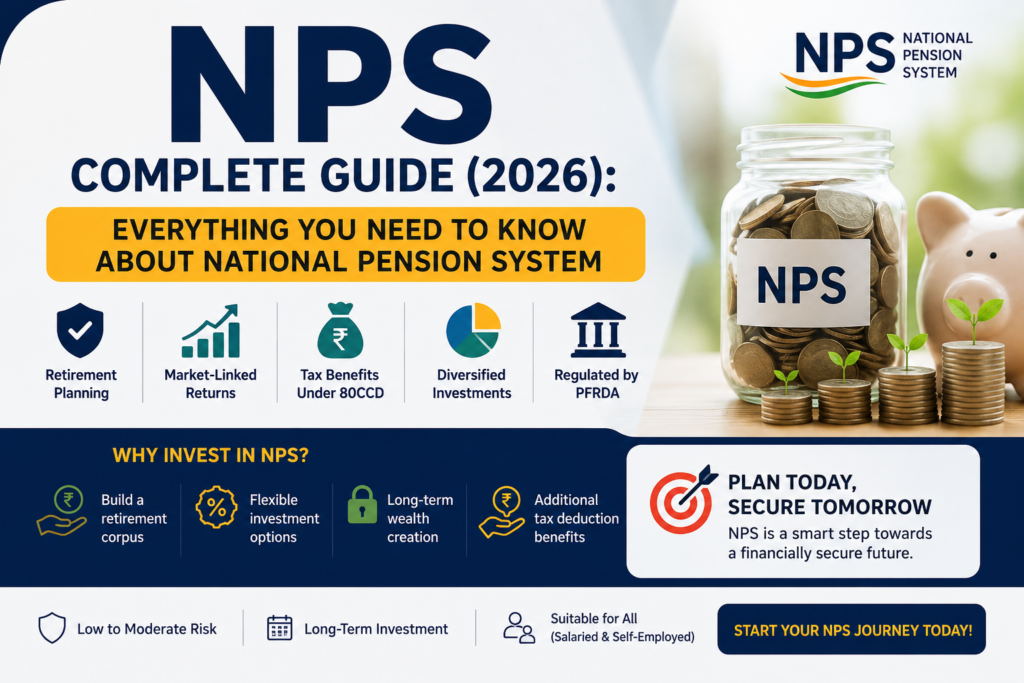
🏦 NPS Complete Guide (2026): Everything You Need to Know About National Pension System
The National Pension System (NPS) is one of India’s most popular retirement-focused investment schemes. Regulated by the Pension Fund Regulatory and Development Authority (PFRDA), NPS helps investors build a retirement corpus through disciplined long-term investing while offering tax benefits under applicable tax laws.
Whether you are a salaried employee, business owner, self-employed professional, or a young investor planning for retirement, this complete guide explains how NPS works, its benefits, eligibility, investment options, withdrawal rules, tax advantages, and how it fits into your long-term financial plan.
📖 Read Complete Guide
What is NPS?
The National Pension System (NPS) is a government-regulated voluntary retirement savings scheme designed to help individuals accumulate wealth for retirement through regular investments. The money is invested across equity, corporate bonds, government securities, and alternative assets based on the selected investment option.
- ✅ Retirement-focused investment.
- ✅ Regulated by PFRDA.
- ✅ Long-term disciplined investing.
- ✅ Market-linked growth potential.
- ✅ Tax-saving opportunities under applicable laws.
Key Features of NPS
| Feature | Details |
|---|---|
| Investment Type | Retirement Pension Scheme |
| Regulator | PFRDA |
| Asset Classes | Equity, Corporate Bonds, Government Securities & Alternative Assets |
| Risk Level | Low to Moderate (Depends on Asset Allocation) |
| Primary Goal | Retirement Corpus Creation |
Benefits of Investing in NPS
- 💰 Long-term retirement planning.
- 📈 Market-linked wealth creation potential.
- 🏦 Tax benefits under applicable tax provisions.
- ⚖ Diversified investment portfolio.
- 💼 Professionally managed pension funds.
- 🎯 Disciplined long-term investing.
Who Should Invest in NPS?
- ✅ Salaried Employees
- ✅ Government Employees
- ✅ Business Owners
- ✅ Self-Employed Professionals
- ✅ Young Investors
- ✅ Retirement Planners
- ✅ Long-Term Wealth Builders
Investment Options in NPS
| Option | Description |
|---|---|
| Active Choice | Investor decides asset allocation. |
| Auto Choice | Asset allocation changes automatically with age. |
NPS vs Other Retirement Investments
| Investment | Risk | Primary Goal |
|---|---|---|
| NPS | Moderate | Retirement Planning |
| PPF | Low | Safe Long-Term Savings |
| EPF | Very Low | Employee Retirement Savings |
| ELSS | Moderate to High | Wealth Creation |
Common Mistakes to Avoid
- ❌ Starting retirement planning too late.
- ❌ Ignoring asset allocation.
- ❌ Not reviewing the NPS portfolio periodically.
- ❌ Choosing investments without understanding risk.
- ❌ Depending only on one retirement product.
Frequently Asked Questions
Q1. Is NPS a good investment for retirement?
NPS is specifically designed for retirement planning and can be an effective tool for building a long-term retirement corpus, depending on your financial goals and risk tolerance.
Q2. Can salaried and self-employed individuals invest in NPS?
Yes. Subject to eligibility criteria, both salaried and self-employed individuals can invest in NPS.
Q3. Does NPS offer tax benefits?
NPS may provide tax benefits under applicable tax laws. Investors should refer to the latest tax provisions or consult a tax advisor.
Q4. Can I invest in both NPS and Mutual Funds?
Yes. Many investors combine NPS with mutual funds as part of a diversified long-term financial and retirement plan.
Key Takeaway
NPS is one of the best retirement-focused investment options available in India. It combines disciplined long-term investing, professional fund management, diversified asset allocation, and tax efficiency to help investors build a retirement corpus. When combined with other investments like mutual funds and PPF, it can play a vital role in a well-balanced financial plan.
Disclaimer: This article is for educational purposes only and should not be considered financial, tax, or investment advice. NPS rules, tax provisions, and investment returns may change over time. Please consult a qualified financial advisor before making investment decisions.