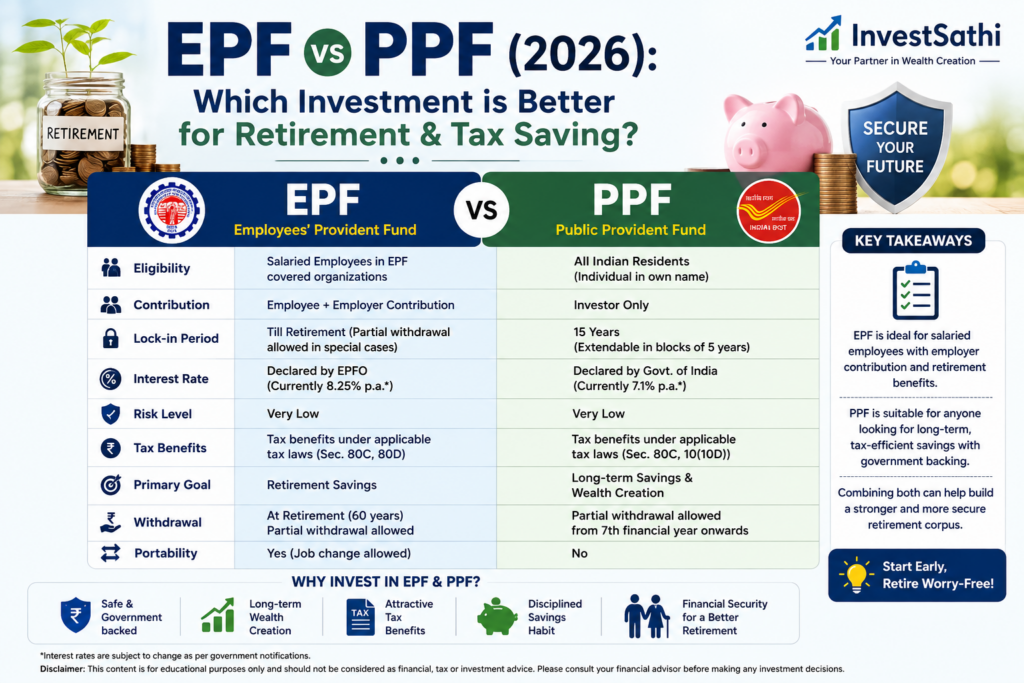
🏦 EPF vs PPF (2026): Which Investment is Better for Retirement & Tax Saving?
EPF (Employees’ Provident Fund) and PPF (Public Provident Fund) are two of the most popular long-term savings schemes in India. Both help investors build a retirement corpus while offering tax benefits under applicable tax laws. However, they differ in eligibility, contributions, liquidity, returns, and overall purpose.
If you are wondering whether EPF or PPF is the better investment, this guide compares both schemes to help you choose the right option based on your financial goals, employment status, and retirement planning needs.
📖 Read Complete Guide
What is EPF?
Employees’ Provident Fund (EPF) is a retirement savings scheme primarily meant for salaried employees working in eligible organizations. Contributions are made by both the employee and employer, helping build a retirement corpus over time.
- ✅ Retirement-focused savings.
- ✅ Employer and employee contributions.
- ✅ Government-regulated scheme.
- ✅ Suitable for salaried employees.
What is PPF?
Public Provident Fund (PPF) is a government-backed long-term savings scheme available to all eligible Indian residents. It is widely used for retirement planning, tax-efficient investing, and long-term wealth creation.
- ✅ Government-backed investment.
- ✅ Long-term savings scheme.
- ✅ Suitable for salaried and self-employed individuals.
- ✅ Capital protection with compounding benefits.
EPF vs PPF Comparison
| Feature | EPF | PPF |
|---|---|---|
| Eligibility | Eligible Salaried Employees | Eligible Indian Residents |
| Investment Type | Provident Fund | Government Savings Scheme |
| Contribution | Employee + Employer | Investor Only |
| Risk Level | Very Low | Very Low |
| Primary Goal | Retirement Savings | Long-Term Savings & Retirement |
When Should You Choose EPF?
- 👨💼 You are a salaried employee.
- 🏢 Your employer contributes to EPF.
- 👴 Your primary goal is retirement planning.
- 💰 You want disciplined monthly savings.
When Should You Choose PPF?
- 🏠 You are self-employed or a business owner.
- 👩💼 You want an additional retirement corpus.
- 💼 You prefer a government-backed investment.
- 📈 You want long-term tax-efficient savings.
Advantages of EPF
- ✅ Employer contribution boosts savings.
- ✅ Automatic monthly investments.
- ✅ Retirement-focused corpus.
- ✅ Government-regulated scheme.
Advantages of PPF
- ✅ Open to eligible individuals.
- ✅ Government-backed security.
- ✅ Long-term compounding benefits.
- ✅ Suitable for diversified retirement planning.
Frequently Asked Questions
Q1. Which is better—EPF or PPF?
Both serve different purposes. EPF is generally suitable for salaried employees, while PPF is available to eligible individuals seeking long-term savings and retirement planning.
Q2. Can I invest in both EPF and PPF?
Yes. Many salaried individuals invest in both schemes to strengthen their retirement planning and diversify their long-term savings.
Q3. Are both eligible for tax benefits?
Subject to applicable tax laws and eligibility, both EPF and PPF may offer tax-related benefits. Always verify the latest tax provisions before investing.
Key Takeaway
EPF and PPF are both excellent long-term savings options. EPF is ideal for eligible salaried employees due to employer contributions, while PPF provides flexibility and government-backed security for a broader range of investors. Combining both can help build a stronger retirement corpus.
Disclaimer: This article is for educational purposes only and should not be considered financial, tax, or investment advice. EPF and PPF rules, interest rates, and tax provisions may change over time. Please consult a qualified financial advisor before making investment decisions.