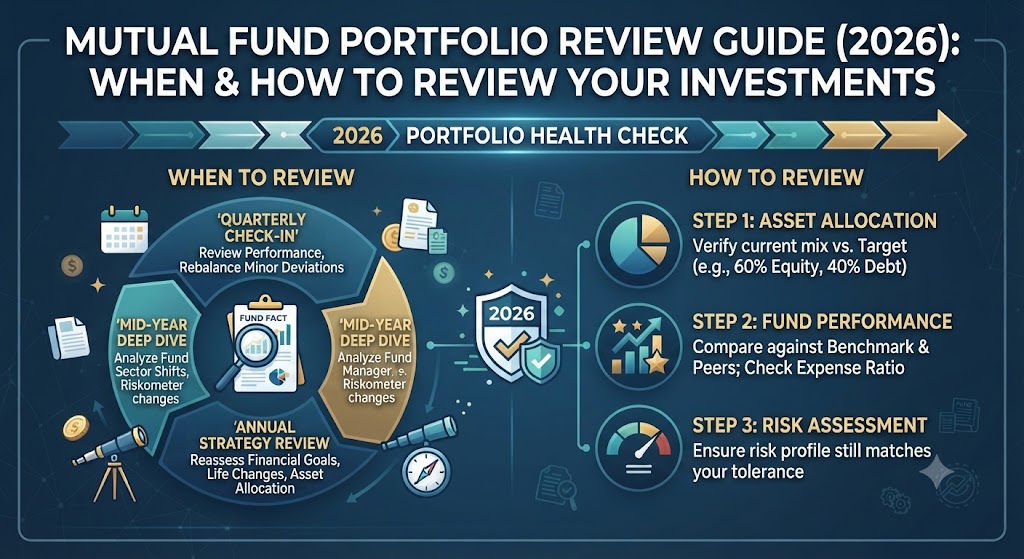
📊 Mutual Fund Portfolio Review Guide (2026): When & How to Review Your Investments
Investing in mutual funds is only the first step toward achieving your financial goals. Regularly reviewing your mutual fund portfolio helps ensure your investments remain aligned with your objectives, risk tolerance, and changing market conditions.
Many investors continue SIPs for years without checking whether their funds are still performing as expected. A periodic portfolio review can help improve long-term investment outcomes and identify areas that may require attention.
📖 Read Complete Guide
What is a Mutual Fund Portfolio Review?
A mutual fund portfolio review is the process of evaluating all your mutual fund investments to determine whether they continue to match your financial goals, investment horizon, and risk profile.
Why is Portfolio Review Important?
- ✅ Ensures investments remain aligned with your financial goals.
- ✅ Identifies consistently underperforming funds.
- ✅ Helps maintain the desired asset allocation.
- ✅ Avoids unnecessary overlap between similar funds.
- ✅ Supports better risk management.
- ✅ Keeps your investment strategy updated with life changes.
How Often Should You Review Your Portfolio?
| Investment Type | Recommended Review Frequency |
|---|---|
| Long-Term SIP Investors | Every 6–12 Months |
| Goal-Based Investments | Annually or Before Major Goals |
| Retirement Portfolio | Once Every Year |
| Market Volatility | Avoid Frequent Reviews Based Only on Market Movements |
Checklist for Reviewing Your Mutual Fund Portfolio
- 📈 Review long-term fund performance.
- 🎯 Confirm investments match your financial goals.
- ⚖ Check your asset allocation.
- 💼 Review portfolio diversification.
- 📊 Compare expense ratios.
- 📅 Assess investment horizon.
- 🔄 Identify overlapping mutual funds.
- 💰 Evaluate SIP contributions.
Signs Your Portfolio May Need Changes
| Situation | Possible Action |
|---|---|
| Financial Goals Have Changed | Review Investment Allocation |
| Risk Appetite Changed | Rebalance Portfolio |
| Fund Underperforming for Long Period | Analyze Before Taking Action |
| Too Many Similar Funds | Reduce Overlap |
Common Portfolio Review Mistakes
- ❌ Reviewing portfolio every week.
- ❌ Switching funds after short-term market corrections.
- ❌ Selecting funds based only on recent returns.
- ❌ Ignoring diversification.
- ❌ Investing in too many mutual funds.
- ❌ Making emotional investment decisions.
Portfolio Review vs Portfolio Rebalancing
| Portfolio Review | Portfolio Rebalancing |
|---|---|
| Evaluates investment performance. | Adjusts asset allocation. |
| Checks goal alignment. | Restores target allocation. |
| Usually annual. | Only when allocation changes significantly. |
Frequently Asked Questions (FAQs)
Q1. How often should I review my mutual fund portfolio?
Most long-term investors can review their portfolio once every 6 to 12 months.
Q2. Should I stop SIP if my fund gives negative returns?
Short-term market fluctuations are common. Decisions should be based on long-term performance and your financial goals rather than temporary declines.
Q3. How many mutual funds should I ideally have?
Many investors can build a diversified portfolio with a limited number of well-chosen funds, depending on their financial goals.
Q4. Should I replace underperforming funds immediately?
Not necessarily. Review the reasons for underperformance, compare with peers and benchmarks, and consider your long-term investment strategy before making changes.
Key Takeaway
Regular portfolio reviews help keep your investments aligned with your financial goals while avoiding unnecessary risks. Focus on long-term performance, proper diversification, and disciplined investing rather than reacting to short-term market movements.
Disclaimer: This article is for educational purposes only and should not be considered financial or investment advice. Mutual fund investments are subject to market risks. Please read all scheme-related documents carefully before investing and consult a qualified financial advisor before making investment decisions.