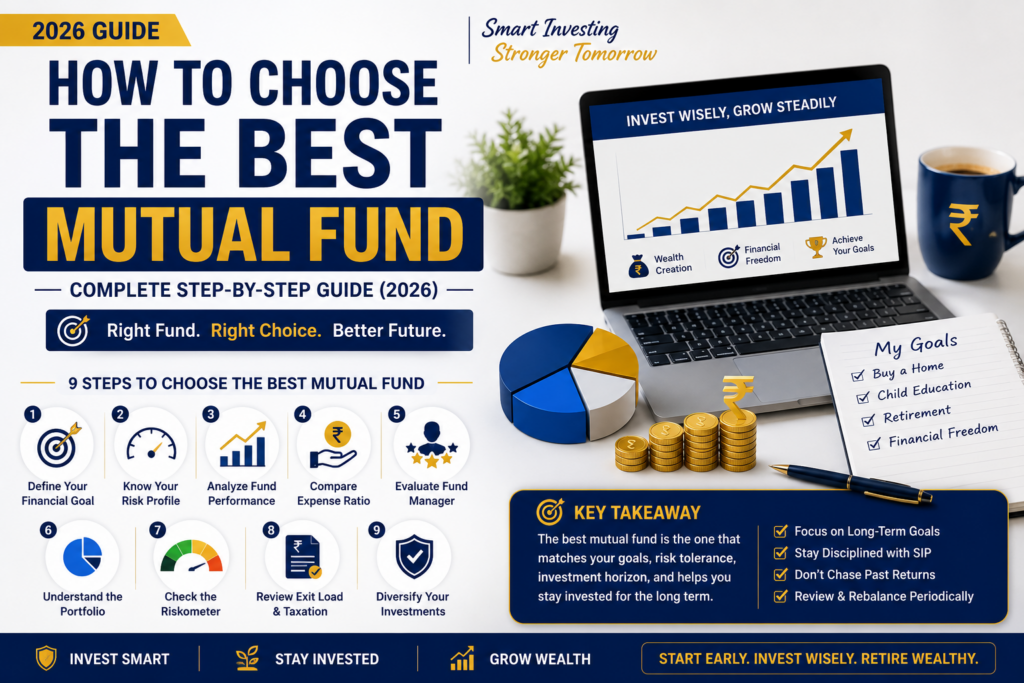
📈 How to Choose the Best Mutual Fund: Complete Step-by-Step Guide (2026)
Choosing the right mutual fund is one of the most important decisions for achieving your financial goals. With thousands of mutual fund schemes available in India, selecting the best one can feel overwhelming for beginners.
This complete 2026 guide explains the key factors you should evaluate before investing in a mutual fund, helping you make informed investment decisions based on your goals and risk profile.
📖 Read Complete Guide
Step 1: Define Your Financial Goal
Before selecting a mutual fund, identify why you are investing. Your investment goal determines the type of mutual fund that may be suitable.
- 🎯 Wealth Creation
- 🎓 Child Education
- 🏠 Home Purchase
- 💼 Retirement Planning
- 🚗 Buying a Car
- 💰 Regular Income
Step 2: Know Your Risk Profile
Every investor has a different risk tolerance. Choose funds that match your comfort level and investment horizon.
| Risk Profile | Suitable Funds |
|---|---|
| Conservative | Debt Funds, Liquid Funds |
| Moderate | Hybrid Funds, Balanced Funds |
| Aggressive | Equity Funds, Index Funds |
Step 3: Check Fund Performance
Review the fund’s historical performance across different market cycles instead of focusing only on recent returns.
- ✅ 3-Year Performance
- ✅ 5-Year Performance
- ✅ 10-Year Performance (if available)
- ✅ Performance compared with benchmark and peers
Step 4: Compare the Expense Ratio
A lower expense ratio means less of your investment is used for fund expenses. However, don’t choose a fund based only on cost—consider overall quality and consistency.
Step 5: Evaluate the Fund Manager
An experienced fund manager with a consistent investment strategy can play an important role in long-term performance.
- ✔ Experience
- ✔ Investment Philosophy
- ✔ Track Record
Step 6: Understand the Portfolio
Review where the mutual fund invests its money.
- 📊 Large Cap Stocks
- 📈 Mid Cap Stocks
- 🚀 Small Cap Stocks
- 🏦 Government Securities
- 💼 Corporate Bonds
- 🌍 Sector Allocation
Step 7: Check the Riskometer
SEBI’s Riskometer helps investors understand the risk level of a mutual fund before investing.
| Risk Level | Suitable For |
|---|---|
| Low | Conservative Investors |
| Moderately Low | Income-Oriented Investors |
| Moderate | Balanced Investors |
| Moderately High | Growth Investors |
| High / Very High | Aggressive Long-Term Investors |
Step 8: Check Exit Load & Taxation
- ✔ Understand Exit Load before investing.
- ✔ Be aware of applicable capital gains tax rules.
- ✔ Invest according to your planned holding period.
Step 9: Diversify Your Investments
Avoid investing all your money in a single mutual fund or one asset class. Diversification can help manage risk.
Common Mistakes to Avoid
- ❌ Investing based only on recent returns.
- ❌ Selecting funds solely because of a low NAV.
- ❌ Ignoring your financial goals.
- ❌ Chasing top-performing funds every year.
- ❌ Investing without understanding the risks.
Frequently Asked Questions (FAQs)
Q1. Which mutual fund is best for beginners?
The best mutual fund depends on your financial goals, investment horizon, and risk tolerance. There is no single fund that is best for everyone.
Q2. Should I choose a fund with the highest returns?
Not always. Evaluate consistency, risk, expense ratio, portfolio quality, and suitability along with historical performance.
Q3. How many mutual funds should I own?
A diversified portfolio is generally preferable to holding too many overlapping schemes. The exact number depends on your goals and investment strategy.
Q4. Is SIP the best way to invest?
For many long-term investors, SIP can be an effective way to invest regularly and manage market volatility. However, suitability depends on individual circumstances.
Key Takeaway
The best mutual fund is the one that matches your financial goals, risk profile, investment horizon, and long-term strategy—not necessarily the one with the highest recent returns.
Disclaimer: This article is for educational purposes only and should not be considered financial, tax, or investment advice. Mutual fund investments are subject to market risks. Please read all scheme-related documents carefully before investing and consult a qualified financial advisor if needed.