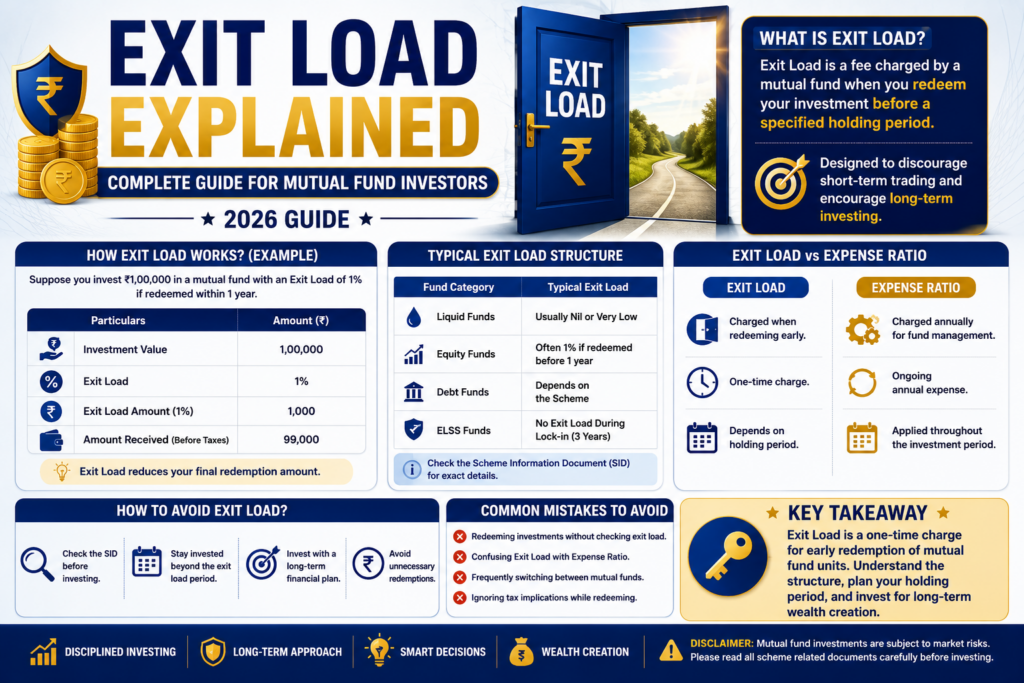
🚪 Exit Load Explained: Complete Guide for Mutual Fund Investors (2026)
If you’re planning to invest in mutual funds, understanding Exit Load is essential. Many investors focus only on returns and overlook exit load, which can reduce the amount you receive when redeeming your investments.
In this complete 2026 guide, you’ll learn what Exit Load is, why Asset Management Companies (AMCs) charge it, how it is calculated, and how to avoid unnecessary charges.
📖 Read Complete Guide
What is Exit Load?
Exit Load is a fee charged by a mutual fund when an investor redeems or withdraws units before a specified holding period. It is designed to discourage short-term trading and protect the interests of long-term investors.
Why Do Mutual Funds Charge Exit Load?
- ✅ To discourage frequent buying and selling.
- ✅ To encourage long-term investing.
- ✅ To reduce the impact of sudden redemptions on the fund.
- ✅ To protect existing investors from unnecessary transaction costs.
How is Exit Load Calculated?
Suppose you invest ₹1,00,000 in a mutual fund with an Exit Load of 1% if redeemed within one year.
| Particular | Amount |
|---|---|
| Investment Value | ₹1,00,000 |
| Exit Load | 1% |
| Exit Load Amount | ₹1,000 |
| Amount Received | ₹99,000 (before taxes) |
Do All Mutual Funds Have Exit Load?
No. Exit Load depends on the type of mutual fund and the scheme’s terms. Some funds have no exit load, while others charge it only if you redeem within a specified period.
| Fund Category | Typical Exit Load |
|---|---|
| Liquid Funds | Usually Nil or Very Low |
| Equity Funds | Often 1% if redeemed before 1 year |
| Debt Funds | Depends on the Scheme |
| ELSS Funds | No Exit Load During Lock-in (3 Years) |
Exit Load vs Expense Ratio
| Exit Load | Expense Ratio |
|---|---|
| Charged when redeeming early. | Charged annually for fund management. |
| One-time charge. | Ongoing annual expense. |
| Depends on holding period. | Applied throughout the investment period. |
How to Avoid Exit Load?
- ✔ Check the Scheme Information Document (SID) before investing.
- ✔ Stay invested beyond the exit load period.
- ✔ Invest with a long-term financial plan.
- ✔ Avoid unnecessary redemptions.
Common Mistakes to Avoid
- ❌ Redeeming investments without checking exit load.
- ❌ Confusing Exit Load with Expense Ratio.
- ❌ Frequently switching between mutual funds.
- ❌ Ignoring tax implications while redeeming.
Frequently Asked Questions (FAQs)
Q1. Is Exit Load the same as tax?
No. Exit Load is charged by the mutual fund, while capital gains tax is levied by the government based on applicable tax laws.
Q2. Is Exit Load applicable after the specified holding period?
Generally, no. Once the exit load period is over, you can redeem without paying exit load, subject to the scheme’s terms.
Q3. Where can I check the Exit Load?
You can find the exit load details in the Scheme Information Document (SID), Key Information Memorandum (KIM), or the AMC’s website.
Q4. Does every SIP installment have a separate Exit Load period?
Yes. Each SIP installment is treated as a separate investment, and its exit load period is calculated individually.
Key Takeaway
Exit Load is a one-time charge for early redemption of mutual fund units. Always review the scheme’s exit load structure before investing and align your investments with your long-term financial goals.
Disclaimer: This article is for educational purposes only and should not be considered financial or investment advice. Mutual fund investments are subject to market risks. Please read all scheme-related documents carefully before investing and consult a qualified financial advisor before making investment decisions.