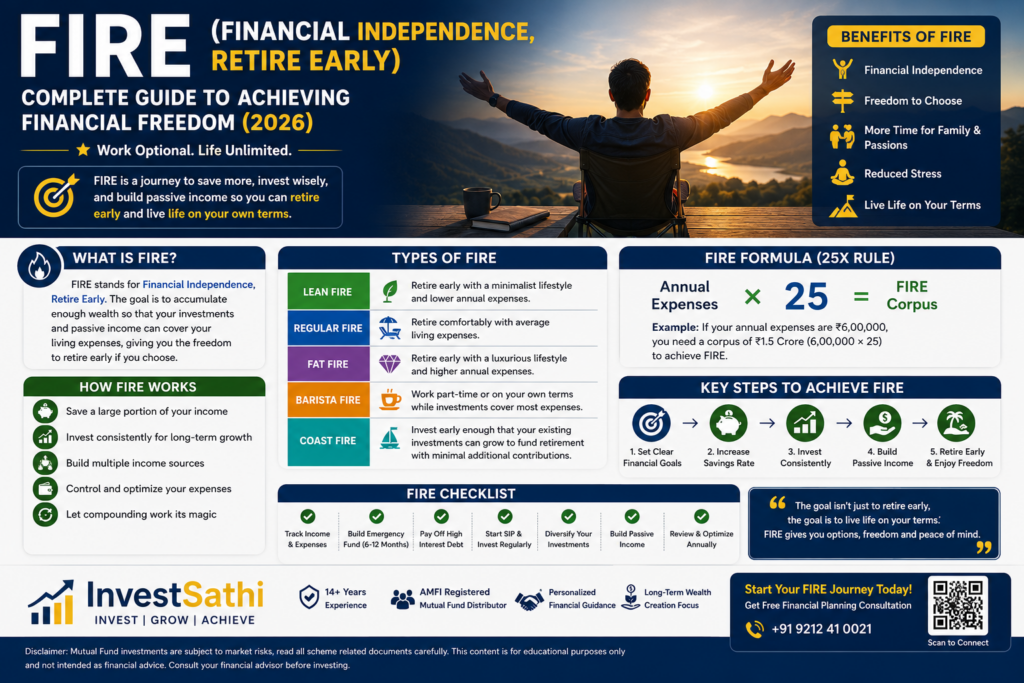
🔥 FIRE (Financial Independence, Retire Early): Complete Guide to Achieving Financial Freedom (2026)
The FIRE (Financial Independence, Retire Early) movement has gained worldwide popularity among people who want to achieve financial freedom and retire earlier than the traditional retirement age. FIRE focuses on disciplined saving, smart investing, controlled spending, and building passive income so that work becomes optional rather than mandatory.
In this complete 2026 guide, you’ll learn what FIRE is, how it works, its different types, benefits, challenges, and practical steps to achieve financial independence.
📖 Read Complete Guide
1. What is FIRE?
FIRE stands for Financial Independence, Retire Early. The goal is to accumulate enough wealth so that your investments and passive income can cover your living expenses, allowing you to retire early if you choose.
2. How Does FIRE Work?
- 💰 Save a large portion of your income.
- 📈 Invest consistently for long-term growth.
- 💼 Build multiple income sources.
- 💳 Control unnecessary expenses.
- ⏳ Allow compounding to grow your wealth.
3. Types of FIRE
| Type | Description |
|---|---|
| Lean FIRE | Retire with a minimalist lifestyle and lower expenses. |
| Regular FIRE | Retire comfortably with average living expenses. |
| Fat FIRE | Retire with a higher lifestyle and larger investment corpus. |
| Barista FIRE | Work part-time while investments cover most expenses. |
| Coast FIRE | Invest early enough that future growth can fund retirement with minimal additional savings. |
4. Benefits of FIRE
- ✅ Financial independence.
- ✅ Freedom to choose your career.
- ✅ Reduced financial stress.
- ✅ More time for family and personal interests.
- ✅ Opportunity to pursue passion projects.
5. Challenges of FIRE
- ⚠ Requires disciplined saving.
- ⚠ Long-term investing requires patience.
- ⚠ Inflation can increase future expenses.
- ⚠ Market volatility may affect investment values.
- ⚠ Healthcare and unexpected costs need planning.
6. Steps to Achieve FIRE
- Create a monthly budget.
- Increase your savings rate.
- Build an emergency fund.
- Invest regularly through SIPs.
- Diversify your portfolio.
- Reduce unnecessary debt.
- Increase your income through career growth or side income.
- Review your financial plan every year.
7. FIRE Planning Checklist
| Task | Status |
|---|---|
| Create Financial Goals | ☐ |
| Track Monthly Expenses | ☐ |
| Build Emergency Fund | ☐ |
| Start SIP Investments | ☐ |
| Review Portfolio Annually | ☐ |
Frequently Asked Questions (FAQs)
Q1. What does FIRE stand for?
FIRE stands for Financial Independence, Retire Early.
Q2. Is FIRE only for high-income earners?
No. Anyone can work toward FIRE by increasing savings, investing consistently, and managing expenses, though the timeline may vary.
Q3. Which investments are commonly used for FIRE?
Many people pursuing FIRE use diversified investments such as mutual funds, index funds, retirement accounts, and other long-term assets based on their goals and risk tolerance.
Q4. Can I still work after achieving FIRE?
Yes. Many people continue working part-time, pursue hobbies, or start businesses after reaching financial independence.
Key Takeaway
FIRE is not simply about retiring early—it is about gaining the freedom to choose how you spend your time. Consistent saving, disciplined investing, and long-term financial planning are the foundation of achieving financial independence.
Disclaimer: This article is for educational purposes only and should not be considered financial, investment, tax, or retirement advice. Investments are subject to market risks. Please read all scheme-related documents carefully before investing and consult a qualified financial advisor where appropriate.