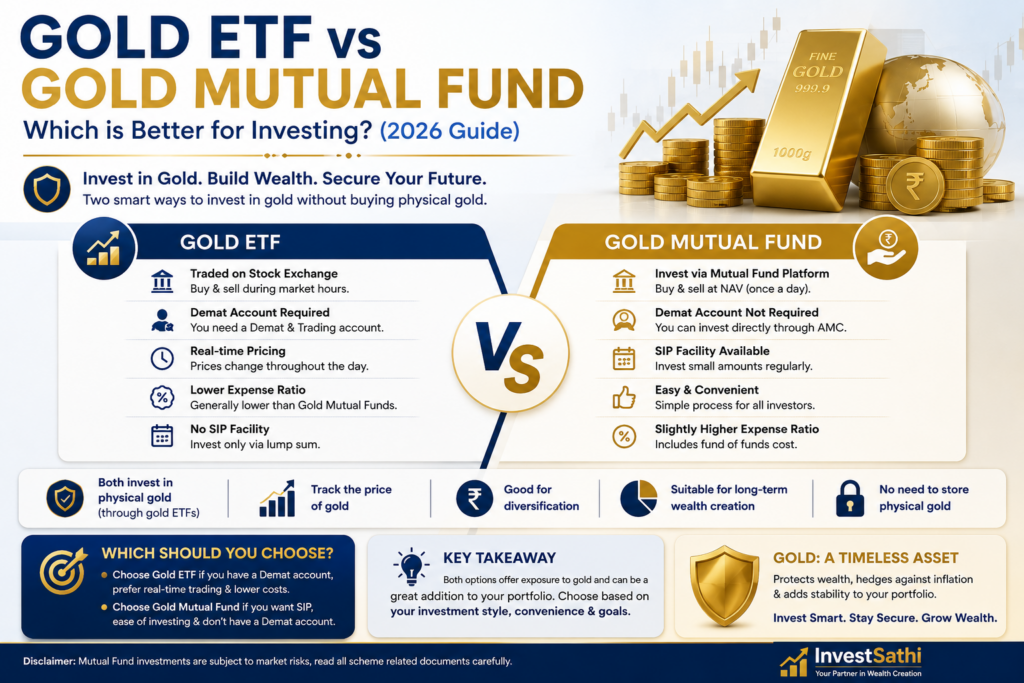
🥇 Gold ETF vs Gold Mutual Fund: Which is Better for Investing? (2026 Guide)
Gold has always been considered an important part of a diversified investment portfolio. Today, investors can gain exposure to gold without buying physical jewellery by investing in Gold ETFs or Gold Mutual Funds. While both options track the price of gold, they differ in the way they are bought, sold, and managed.
In this complete guide, you’ll learn the differences between Gold ETFs and Gold Mutual Funds, their advantages, disadvantages, costs, and which option may be suitable for your investment goals.
📖 Read Complete Guide
1. What is a Gold ETF?
A Gold Exchange Traded Fund (Gold ETF) is an investment fund that tracks the domestic price of physical gold. Gold ETFs are listed on stock exchanges and are bought and sold through a Demat and Trading Account, similar to shares.
2. What is a Gold Mutual Fund?
A Gold Mutual Fund is an open-ended mutual fund that generally invests in Gold ETFs. Investors can invest directly through a Mutual Fund platform without requiring a Demat Account.
3. Gold ETF vs Gold Mutual Fund
| Feature | Gold ETF | Gold Mutual Fund |
|---|---|---|
| Demat Account | Required | Not Required |
| Trading | Stock Exchange | AMC / Mutual Fund Platform |
| Liquidity | Market Hours | Based on NAV |
| SIP Facility | Generally Not Available | Available in Most Schemes |
| Ease of Investing | Moderate | Easy |
4. Benefits of Gold ETFs
- ✅ Traded on stock exchanges.
- ✅ Transparent pricing during market hours.
- ✅ Generally lower expense ratio than Gold Mutual Funds.
- ✅ Suitable for investors with a Demat Account.
5. Benefits of Gold Mutual Funds
- ✅ No Demat Account required.
- ✅ SIP investment facility available in many schemes.
- ✅ Simple investment process.
- ✅ Suitable for first-time investors.
6. Risks to Consider
- ⚠ Gold prices can fluctuate significantly.
- ⚠ Gold does not generate regular income like dividends or interest.
- ⚠ Returns depend on gold price movements.
- ⚠ Expense ratios and tracking differences may affect returns.
7. Who Should Choose Which?
- 👨💼 Choose Gold ETF if you have a Demat Account and prefer exchange-traded investments.
- 📈 Choose Gold Mutual Fund if you want SIP investments and a simpler investing experience.
- 🎯 Both can help diversify a long-term investment portfolio.
Common Mistakes to Avoid
- ❌ Investing only in gold without diversification.
- ❌ Buying based on short-term price movements.
- ❌ Ignoring expense ratios and costs.
- ❌ Expecting guaranteed returns.
- ❌ Investing without clear financial goals.
Frequently Asked Questions (FAQs)
Q1. Which is better: Gold ETF or Gold Mutual Fund?
The choice depends on your investment preferences. Gold ETFs require a Demat Account, while Gold Mutual Funds are easier for investors who prefer investing directly through mutual fund platforms.
Q2. Can I invest in Gold Mutual Funds through SIP?
Yes. Many Gold Mutual Fund schemes offer SIP facilities.
Q3. Do Gold ETFs invest in physical gold?
Gold ETFs are designed to track the domestic price of physical gold through investments in gold-related assets as per the scheme’s investment objective.
Q4. Is gold a complete investment portfolio?
No. Gold is generally considered a diversification asset and should usually be part of a broader, well-diversified investment portfolio.
Key Takeaway
Gold ETFs and Gold Mutual Funds both provide exposure to gold without the need to buy physical gold. The right choice depends on your investment style, account setup, and financial goals.
Final Thoughts
Adding gold to your portfolio may improve diversification, but it should complement—not replace—your investments in equity, debt, and other asset classes. Before investing, evaluate your risk profile and long-term financial objectives.
Disclaimer: This article is for educational purposes only and should not be considered financial or investment advice. Mutual Fund investments and Gold ETFs are subject to market risks. Please read all scheme-related documents carefully before investing.