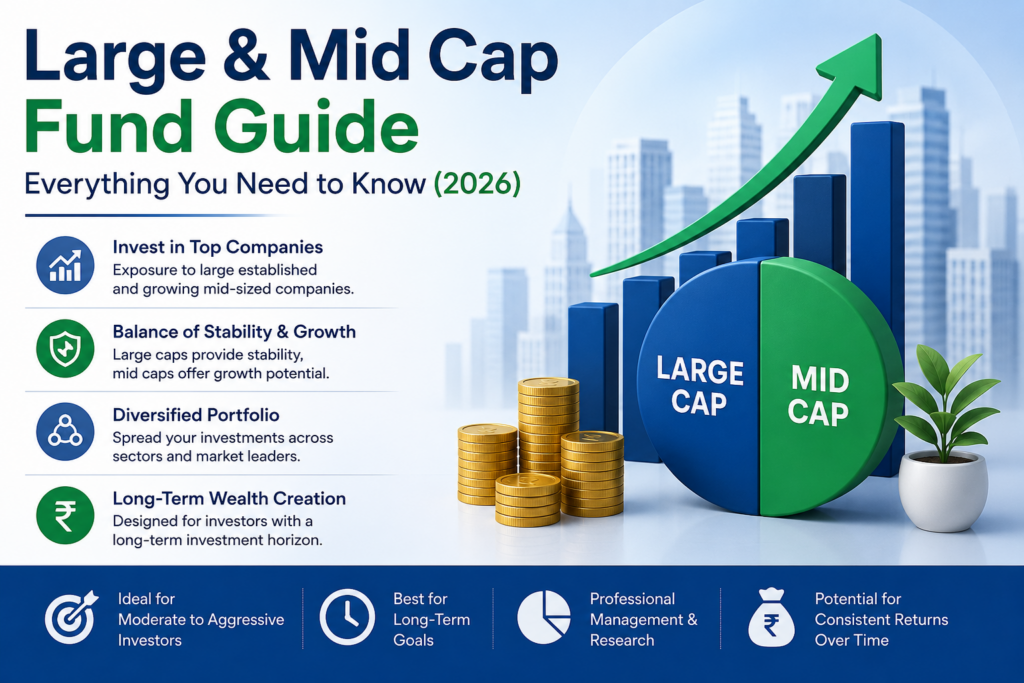
📈 Large & Mid Cap Fund Guide: Everything You Need to Know (2026)
Large & Mid Cap Funds are equity mutual funds that invest in a combination of large-cap and mid-cap companies. These funds aim to provide a balance between the stability of established companies and the higher growth potential of emerging businesses.
In this complete guide, you’ll learn how Large & Mid Cap Funds work, their benefits, risks, who should invest, and how they compare with other equity mutual fund categories.
📖 Read Complete Guide
1. What is a Large & Mid Cap Fund?
A Large & Mid Cap Fund is an equity mutual fund category that invests in both large-cap and mid-cap companies. As per SEBI regulations, these funds generally invest at least 35% in Large Cap stocks and 35% in Mid Cap stocks, with the remaining allocation managed according to the fund’s investment strategy.
2. How Does a Large & Mid Cap Fund Work?
- ✅ Invests in leading blue-chip companies for stability.
- ✅ Invests in mid-cap companies for higher growth potential.
- ✅ Offers a balanced equity portfolio.
- ✅ Managed by professional fund managers.
- ✅ Suitable for long-term wealth creation.
3. Large Cap vs Mid Cap vs Large & Mid Cap
| Feature | Large Cap | Mid Cap | Large & Mid Cap |
|---|---|---|---|
| Risk | Low to Moderate | Moderate to High | Moderate |
| Growth Potential | Moderate | High | Balanced |
| Volatility | Lower | Higher | Moderate |
| Best For | Conservative Equity Investors | Aggressive Investors | Balanced Growth Investors |
4. Benefits of Large & Mid Cap Funds
- ✅ Balanced exposure to stable and growing companies.
- ✅ Better diversification within equity investments.
- ✅ Opportunity to participate in long-term market growth.
- ✅ Professional portfolio management.
- ✅ Suitable for SIP and Lump Sum investments.
5. Who Should Invest?
- 👨💼 Investors with a 5–10 year investment horizon.
- 📈 Investors seeking long-term capital appreciation.
- 🎯 Investors comfortable with moderate market risk.
- 💰 Investors looking for a balance between stability and growth.
6. Risks to Consider
- ⚠ Market volatility may affect fund performance.
- ⚠ Mid-cap stocks can experience higher price fluctuations.
- ⚠ Returns are not guaranteed.
- ⚠ Short-term investments may be affected by market cycles.
7. Common Mistakes to Avoid
- ❌ Investing for very short-term goals.
- ❌ Expecting guaranteed returns.
- ❌ Stopping SIPs during market corrections.
- ❌ Ignoring your risk profile and financial goals.
- ❌ Choosing funds only based on recent performance.
Frequently Asked Questions (FAQs)
Q1. Are Large & Mid Cap Funds suitable for beginners?
They may be suitable for investors seeking diversified equity exposure with a long-term investment horizon, depending on their risk profile.
Q2. Can I invest through SIP?
Yes. Most Large & Mid Cap Funds allow both SIP and Lump Sum investments.
Q3. What is the recommended investment horizon?
Generally, an investment horizon of at least 5 years is considered suitable for equity-oriented funds.
Q4. Are returns guaranteed?
No. Mutual Fund returns depend on market performance and are not guaranteed.
Key Takeaway
Large & Mid Cap Funds combine the stability of large-cap companies with the growth potential of mid-cap businesses, making them a suitable option for investors seeking balanced long-term wealth creation through equity mutual funds.
Final Thoughts
Large & Mid Cap Funds can be a valuable addition to a long-term investment portfolio. Before investing, evaluate your financial goals, investment horizon, and risk tolerance, and ensure the fund aligns with your overall financial plan.
Disclaimer: This article is for educational purposes only and should not be considered financial or investment advice. Mutual Fund investments are subject to market risks. Please read all scheme-related documents carefully before investing.