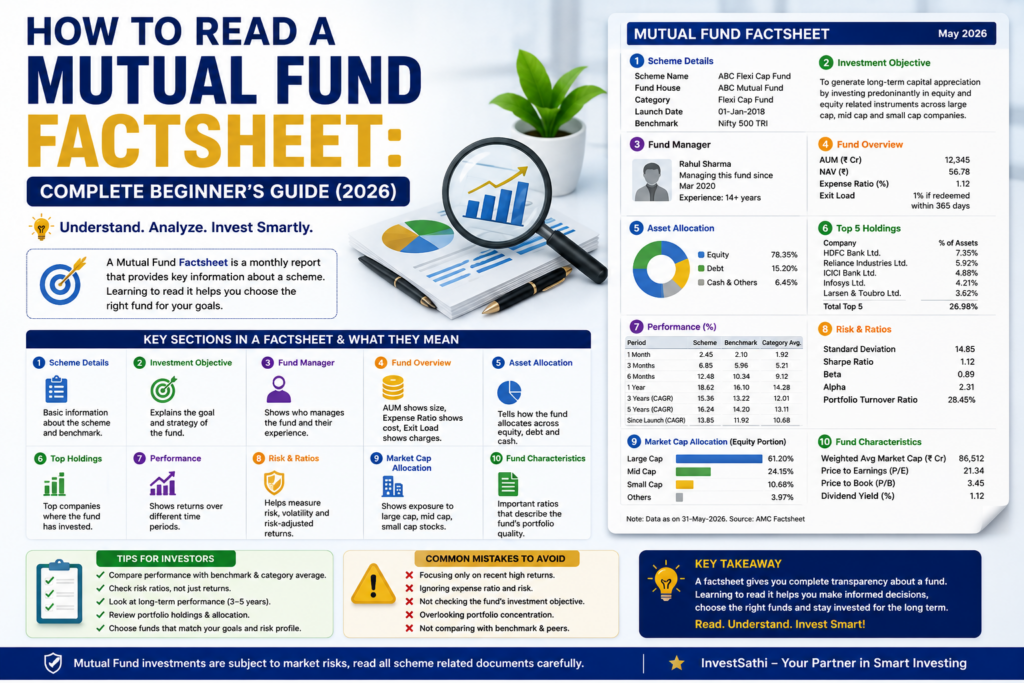
📄 How to Read a Mutual Fund Factsheet: Complete Beginner’s Guide (2026)
A Mutual Fund Factsheet is a monthly document published by every Asset Management Company (AMC) that provides detailed information about a mutual fund scheme. Learning how to read a factsheet helps investors evaluate fund performance, risk, portfolio quality, costs, and suitability before investing.
In this guide, you’ll learn how to understand every important section of a Mutual Fund Factsheet and make smarter investment decisions.
📖 Read Complete Guide
1. What is a Mutual Fund Factsheet?
A Mutual Fund Factsheet is a summary report that shows important details about a scheme, including fund objectives, portfolio holdings, returns, risk measures, expense ratio, fund manager details, and asset allocation.
2. Key Information in a Mutual Fund Factsheet
| Section | Why It Matters |
|---|---|
| Fund Objective | Shows the investment goal of the scheme. |
| Fund Manager | Provides details of the person managing the fund. |
| AUM (Assets Under Management) | Indicates the total assets managed by the fund. |
| Expense Ratio | Shows the annual cost of managing the fund. |
| Portfolio Holdings | Lists the securities held by the fund. |
| Asset Allocation | Displays the allocation across Equity, Debt, Cash, etc. |
| Performance | Shows historical returns over different periods. |
| Benchmark | Compares the fund’s performance with a market index. |
3. Important Ratios to Understand
- 📊 Expense Ratio – Lower costs may improve long-term returns.
- 📈 Alpha – Measures performance relative to the benchmark.
- ⚖️ Beta – Measures sensitivity to market movements.
- 📉 Standard Deviation – Indicates volatility.
- 🏆 Sharpe Ratio – Measures risk-adjusted return.
- 📌 Portfolio Turnover Ratio – Shows how frequently the portfolio is changed.
4. How to Evaluate a Mutual Fund Factsheet
- ✅ Check whether the fund objective matches your financial goals.
- ✅ Compare long-term performance instead of short-term returns.
- ✅ Review expense ratio and risk indicators.
- ✅ Analyze portfolio diversification.
- ✅ Compare the fund with its benchmark and peer funds.
5. Common Mistakes to Avoid
- ❌ Investing only based on recent returns.
- ❌ Ignoring expense ratio.
- ❌ Not checking portfolio concentration.
- ❌ Ignoring risk metrics.
- ❌ Selecting funds without understanding the investment objective.
6. Why Factsheets Are Important
- ✔ Better investment decisions.
- ✔ Portfolio transparency.
- ✔ Risk assessment.
- ✔ Easier fund comparison.
- ✔ Improved long-term investing discipline.
Frequently Asked Questions (FAQs)
Q1. How often is a Mutual Fund Factsheet updated?
Most AMCs publish a new factsheet every month.
Q2. Is a higher AUM always better?
Not necessarily. AUM is only one factor and should be considered along with the fund’s strategy, performance, and suitability.
Q3. Why is the Expense Ratio important?
It represents the annual cost of managing the fund. Lower costs can positively impact long-term returns, all else being equal.
Q4. Can beginners use a Mutual Fund Factsheet?
Yes. Once you understand the key sections and ratios, a factsheet becomes a valuable tool for evaluating mutual funds.
Key Takeaway
A Mutual Fund Factsheet provides essential information about a fund’s objectives, portfolio, costs, risk, and performance. Reading it carefully helps you make informed investment decisions instead of relying only on past returns.
Final Thoughts
Before investing in any Mutual Fund, take a few minutes to review its factsheet. Understanding the fund’s objective, portfolio composition, expense ratio, and risk metrics can help you choose investments that align with your financial goals and risk tolerance.
Disclaimer: This article is for educational purposes only and should not be considered financial or investment advice. Mutual Fund investments are subject to market risks. Please read all scheme-related documents carefully before investing.