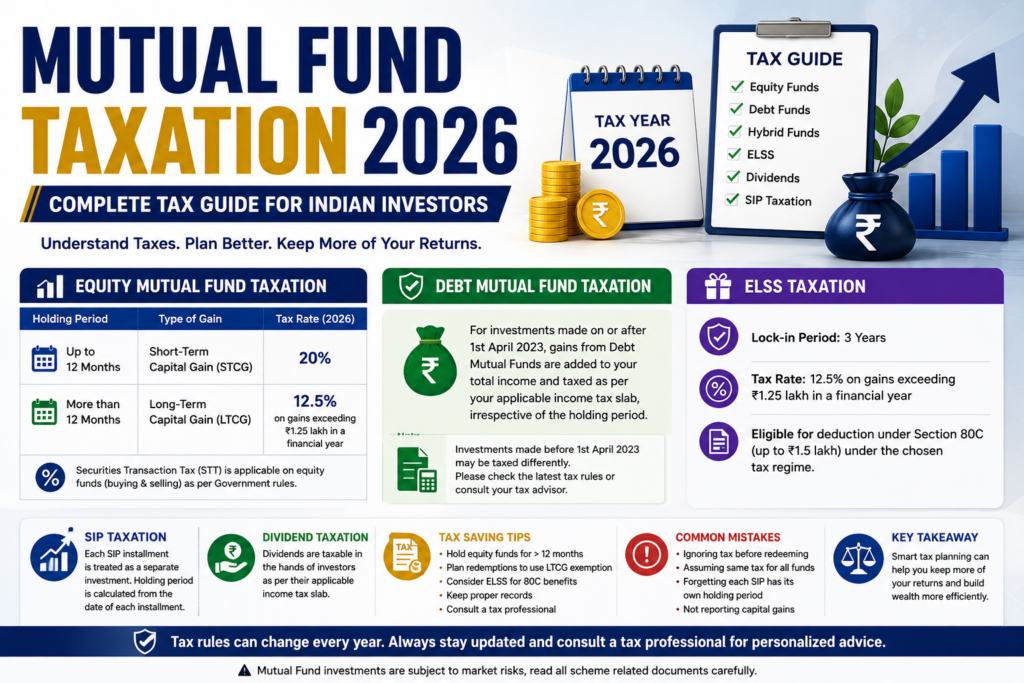
💰 Mutual Fund Taxation 2026: Complete Tax Guide for Indian Investors
Understanding Mutual Fund Taxation is essential because taxes directly impact your investment returns. The tax treatment depends on the type of Mutual Fund (Equity or Debt), the holding period, and the applicable capital gains rules.
This 2026 guide explains how Equity, Hybrid, Debt, ELSS, SIPs, and dividends are taxed in India so you can make informed investment decisions.
📖 Read Complete Guide
1. How Mutual Funds are Taxed
Mutual Fund taxation is based on:
- ✅ Type of Mutual Fund
- ✅ Holding Period
- ✅ Capital Gains (Short-Term or Long-Term)
- ✅ Applicable Income Tax Rules
2. Equity Mutual Fund Taxation (2026)
| Holding Period | Tax Type | Tax Rate |
|---|---|---|
| Up to 12 Months | Short-Term Capital Gain (STCG) | 20% |
| More than 12 Months | Long-Term Capital Gain (LTCG) | 12.5% on gains exceeding ₹1.25 lakh in a financial year |
3. Debt Mutual Fund Taxation
For most Debt Mutual Fund investments made on or after 1 April 2023, gains are generally added to your taxable income and taxed according to your applicable income tax slab, irrespective of the holding period. Older investments may follow different transitional rules. :contentReference[oaicite:0]{index=0}
4. ELSS Taxation
- ✅ Lock-in Period: 3 Years
- ✅ LTCG Tax: 12.5% above ₹1.25 lakh annual exemption.
- ✅ Eligible for tax deduction under Section 80C (subject to applicable limits under the chosen tax regime).
5. SIP Taxation
Each SIP installment is treated as a separate investment. The holding period for each installment is calculated individually from its purchase date.
- 📅 Each SIP installment has its own purchase date.
- 📈 Capital gains are calculated separately for every redemption.
- 💰 FIFO (First In, First Out) method generally applies while redeeming SIP units.
6. Dividend Taxation
Dividends received from Mutual Funds are taxable according to the investor’s applicable income tax slab. They are added to your total taxable income. :contentReference[oaicite:1]{index=1}
7. Tax Saving Tips
- ✅ Hold Equity Funds for more than 12 months where appropriate.
- ✅ Plan redemptions carefully to make efficient use of the annual LTCG exemption.
- ✅ Consider ELSS for eligible tax-saving investments.
- ✅ Maintain proper investment records.
- ✅ Consult a tax professional for complex situations.
Common Mistakes to Avoid
- ❌ Ignoring tax implications before redeeming investments.
- ❌ Assuming all Mutual Funds are taxed the same way.
- ❌ Forgetting that each SIP installment has a separate holding period.
- ❌ Missing capital gains reporting in your Income Tax Return.
- ❌ Investing only for tax benefits without considering financial goals.
Frequently Asked Questions (FAQs)
Q1. What is the LTCG tax on Equity Mutual Funds in 2026?
Long-term capital gains are taxed at 12.5% on gains exceeding ₹1.25 lakh in a financial year. :contentReference[oaicite:2]{index=2}
Q2. What is the STCG tax on Equity Mutual Funds?
Short-term capital gains on Equity Mutual Funds are taxed at 20%. :contentReference[oaicite:3]{index=3}
Q3. Are Debt Mutual Funds taxed differently?
Yes. For most investments made on or after 1 April 2023, gains are generally taxed according to your applicable income tax slab. :contentReference[oaicite:4]{index=4}
Q4. Is dividend from Mutual Funds tax-free?
No. Dividends are generally taxable in the hands of the investor according to the applicable income tax rules. :contentReference[oaicite:5]{index=5}
Key Takeaway
Understanding Mutual Fund taxation helps you make better investment decisions, reduce unnecessary tax outgo, and improve your post-tax returns through proper planning.
Final Thoughts
Tax rules can change over time. Before redeeming Mutual Fund investments, review the latest tax provisions and consider consulting a qualified tax advisor or financial planner to understand how the rules apply to your situation.
Disclaimer: This article is for educational purposes only and should not be considered tax or investment advice. Tax laws may change, and their application depends on individual circumstances. Mutual Fund investments are subject to market risks. Please read all scheme-related documents carefully before investing.