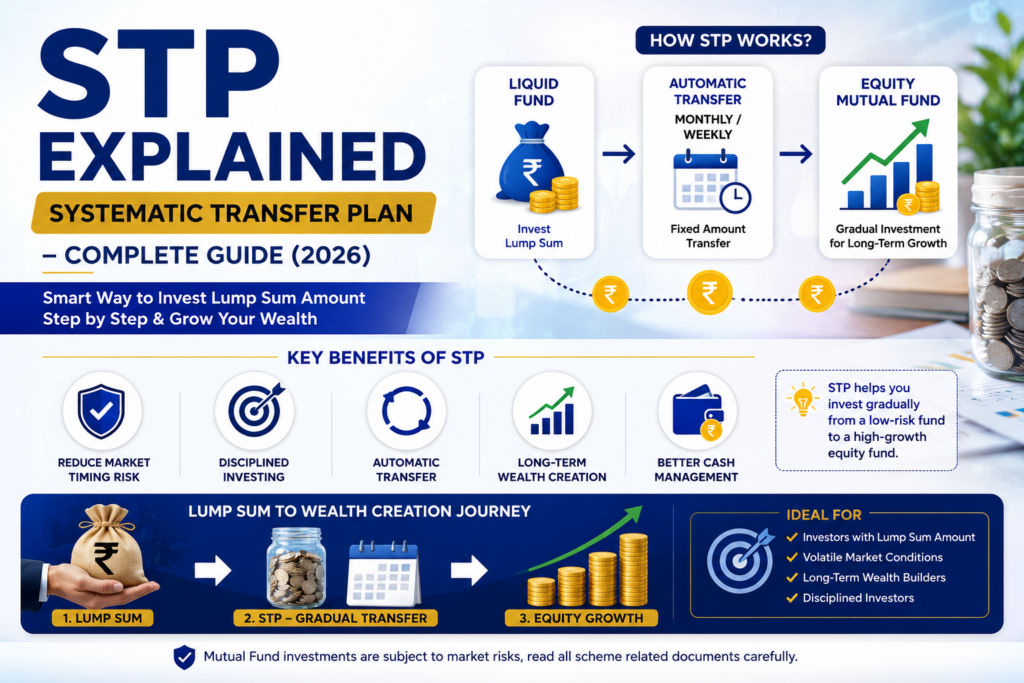
🔄 STP Explained: Systematic Transfer Plan – Complete Guide (2026)
A Systematic Transfer Plan (STP) is a facility offered by Mutual Funds that allows investors to transfer a fixed amount periodically from one Mutual Fund scheme (usually a Debt or Liquid Fund) to another scheme (typically an Equity Fund). It helps investors gradually invest their lump-sum money while reducing the impact of market volatility.
In this guide, you’ll learn how STP works, its benefits, when to use it, and how it differs from SIP and SWP.
📖 Read Complete Guide
1. What is STP?
A Systematic Transfer Plan (STP) enables you to invest a lump sum in a low-risk Mutual Fund, such as a Liquid or Debt Fund, and gradually transfer a fixed amount into an Equity Mutual Fund at regular intervals.
2. How Does STP Work?
- ✅ Invest a lump sum in a Liquid or Debt Fund.
- ✅ Decide the transfer amount.
- ✅ Choose transfer frequency (Daily, Weekly, Monthly, etc.).
- ✅ Money is automatically transferred to the selected Equity Fund.
- ✅ Helps reduce market timing risk through phased investing.
3. STP vs SIP vs SWP
| Feature | SIP | STP | SWP |
|---|---|---|---|
| Purpose | Regular Investment | Transfer Between Funds | Regular Withdrawal |
| Source | Bank Account | Mutual Fund | Mutual Fund |
| Best For | Monthly Investors | Lump Sum Investors | Regular Income |
| Cash Flow | Investment | Fund Transfer | Withdrawal |
4. Benefits of STP
- ✅ Reduces market timing risk.
- ✅ Makes lump-sum investing more disciplined.
- ✅ Potentially earns returns while money waits in a Debt/Liquid Fund.
- ✅ Automatic investment process.
- ✅ Helps maintain investment discipline.
5. Who Should Use STP?
- 💰 Investors with a large lump sum.
- 📈 Investors entering volatile equity markets.
- 🎯 Long-term wealth creators.
- 👨💼 Investors wanting gradual equity exposure.
6. Common Mistakes to Avoid
- ❌ Investing directly in Equity during high market volatility without a plan.
- ❌ Ignoring exit load and taxation.
- ❌ Selecting the wrong transfer frequency.
- ❌ Not reviewing your investment goals.
- ❌ Assuming STP eliminates all market risk.
7. Things to Consider Before Starting STP
- 📊 Market conditions.
- 💰 Amount available for investment.
- 📅 Investment horizon.
- ⚖️ Risk tolerance.
- 🎯 Financial goals.
Frequently Asked Questions (FAQs)
Q1. What is STP in Mutual Funds?
STP allows you to periodically transfer money from one Mutual Fund scheme to another, usually from a Debt Fund to an Equity Fund.
Q2. Is STP better than investing a lump sum directly?
For some investors, STP can reduce the risk of investing all the money at one point in time, especially during volatile markets. It does not guarantee better returns.
Q3. Can I stop my STP anytime?
Yes. Most fund houses allow you to modify or stop your STP as per their terms and conditions.
Q4. Is STP suitable for beginners?
STP can be useful for investors who have a lump sum and want to gradually invest in Equity Mutual Funds instead of investing all at once.
Key Takeaway
A Systematic Transfer Plan (STP) helps investors gradually move a lump-sum investment into Equity Mutual Funds. It promotes disciplined investing and may reduce market timing risk, but investment decisions should always align with your financial goals and risk profile.
Final Thoughts
If you have a large amount ready to invest but are concerned about market volatility, an STP can be a practical approach. Before starting, understand the scheme features, tax implications, exit loads, and ensure the strategy fits your long-term financial plan.
Disclaimer: This article is for educational purposes only and should not be considered financial or investment advice. Mutual Fund investments are subject to market risks. Please read all scheme-related documents carefully before investing.