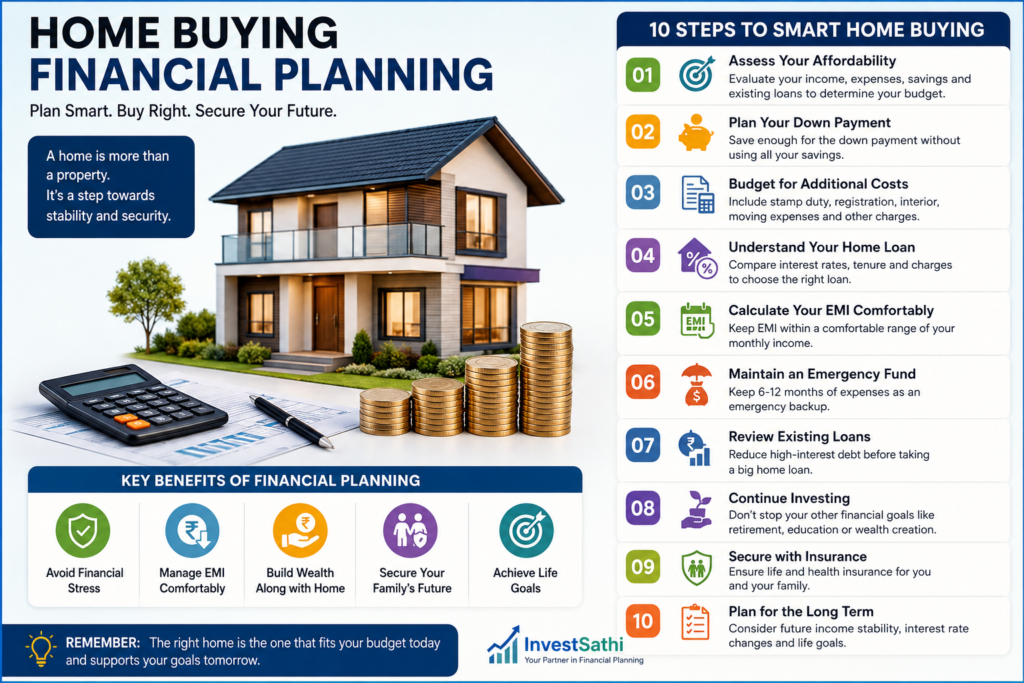
🏠 Home Buying Financial Planning: A Complete Guide to Buying Your Dream Home
Buying a home is one of the biggest financial decisions most people make. A home provides security and stability, but purchasing one without proper financial planning can put significant pressure on your monthly budget.
A well-planned home-buying strategy should cover the down payment, home loan, registration and other purchase costs, monthly EMI, emergency fund and your long-term financial goals.
What Is Home Buying Financial Planning?
Home buying financial planning is the process of determining how much home you can realistically afford and preparing your finances for the purchase without compromising your other important financial goals.
The right home is not simply the home you can get a loan for. It is the home you can comfortably afford while continuing to manage your other financial responsibilities.
Why Financial Planning Is Important Before Buying a Home
- Helps determine an affordable property budget.
- Helps prepare for the down payment.
- Helps estimate the actual cost of buying a property.
- Helps keep the home loan EMI manageable.
- Reduces the risk of excessive borrowing.
- Protects your emergency fund and other financial goals.
Step 1: Determine How Much Home You Can Afford
Before searching for a property, evaluate your income, regular expenses, existing EMIs, savings and future financial commitments.
Do not determine your property budget only by looking at the maximum loan amount a lender may offer. Your personal affordability should be the starting point.
Step 2: Plan Your Down Payment
A home purchase generally requires the buyer to contribute part of the purchase cost from their own funds. The exact amount depends on the property, lender, loan structure and applicable rules.
Start building your down-payment fund well in advance instead of relying entirely on borrowed money.
Do not use every rupee of your savings for the down payment. Keep an appropriate emergency reserve and account for other purchase-related expenses.
Step 3: Budget for Additional Home-Buying Costs
The property’s quoted price may not represent the total amount you need to arrange. Depending on the transaction, there can be additional expenses.
| Expense | Planning Requirement |
|---|---|
| Down Payment | Arrange from your own funds |
| Stamp Duty & Registration | Budget according to applicable local charges |
| Loan Processing & Related Charges | Check lender-specific charges |
| Interior & Furnishing | Estimate separately |
| Moving Expenses | Keep a separate provision |
| Maintenance / Society Charges | Consider ongoing costs |
Step 4: Understand Your Home Loan EMI
A home loan can make purchasing a property more manageable, but the EMI becomes a long-term financial commitment.
Before taking a loan, consider the loan amount, interest rate, tenure, processing charges, prepayment conditions and total repayment obligation.
If you borrow ₹40 lakh for your home, the actual repayment amount will depend on the interest rate and loan tenure. A longer tenure may reduce the monthly EMI but can increase the total interest paid over the life of the loan.
Step 5: Maintain an Emergency Fund
One of the biggest mistakes home buyers make is using all their savings for the property purchase and leaving no cash reserve for emergencies.
Before finalizing the purchase, make sure you have an appropriate emergency fund based on your income, expenses, job stability and family responsibilities.
Step 6: Consider Your Existing Loans
If you already have personal loans, car loans, credit-card balances or other significant liabilities, carefully assess how a new home loan will affect your overall monthly cash flow.
Reducing expensive debt before taking a large long-term loan may improve your financial flexibility.
Step 7: Continue Investing for Other Goals
Buying a home should not automatically mean stopping every other investment.
You may still have important goals such as:
- Emergency fund
- Child’s education
- Retirement
- Insurance protection
- Marriage planning
- Long-term wealth creation
Try to create a balance between your home purchase and these long-term objectives.
Step 8: Start a Home Purchase Fund
If you plan to purchase a home several years from now, create a dedicated home-buying fund.
Regular savings or investments can help you build the required down payment over time. The investment choice should depend on the time available, your risk profile and when the money will be required.
Step 9: Plan for Future Interest Rate Changes
If you choose a floating-rate home loan, your EMI or loan tenure may change when interest rates change, depending on the loan terms.
Therefore, avoid stretching your monthly budget to the maximum limit. Keeping some financial flexibility can make it easier to handle changes in borrowing costs.
Step 10: Check Your Financial Readiness
Before booking a property, ask yourself:
- Do I have sufficient funds for the down payment?
- Have I budgeted for registration and other purchase expenses?
- Can I comfortably manage the expected EMI?
- Do I have an emergency fund?
- Do I have adequate insurance protection?
- Can I continue my important investments?
- Will the purchase affect my other financial goals?
Home Buying vs Renting: Questions to Consider
Buying a home is not always the only financially sensible option. Your decision should depend on your location, expected stay, income stability, property prices, rent, loan cost and personal preferences.
| Buying May Suit You When | Renting May Suit You When |
|---|---|
| You plan to stay for a long period | You may relocate frequently |
| You have stable income | Income or location is uncertain |
| You have sufficient down payment | You want greater financial flexibility |
| The EMI fits comfortably within your budget | Buying would create excessive financial pressure |
Common Home Buying Mistakes
| Mistake | Better Approach |
|---|---|
| Buying beyond your affordability | Set a realistic property budget |
| Using all savings for down payment | Maintain an emergency reserve |
| Ignoring additional costs | Prepare a complete purchase budget |
| Focusing only on EMI | Consider total loan repayment cost |
| Stopping all investments | Balance home purchase with other goals |
Home Buying Financial Planning Checklist
- ✔ Define your property requirement
- ✔ Determine an affordable purchase budget
- ✔ Build your down-payment fund
- ✔ Estimate registration and other purchase costs
- ✔ Compare suitable home-loan options
- ✔ Calculate the expected EMI
- ✔ Maintain an emergency fund
- ✔ Review existing loans and liabilities
- ✔ Maintain adequate insurance protection
- ✔ Continue planning for other financial goals
- ✔ Review your overall financial plan before purchasing
Final Thoughts
Buying a home can be a major step toward financial stability, but it should be approached with careful planning. The goal is not simply to own a property — it is to own a home without putting your overall financial future under unnecessary pressure.
Start early, build your down payment, understand the total cost of ownership, keep your EMI manageable and continue working toward your other important financial goals.
Plan Your Home. Protect Your Future.
Buy a home that fits your life — and a financial plan that protects your future.
InvestSathi – Your Partner in Financial Planning
Disclaimer: The information provided is for educational purposes only and should not be considered financial, legal, tax or investment advice. Home loan interest rates, charges, eligibility criteria and applicable property-related costs may vary by lender, location and individual circumstances. Investment returns are market-linked and not guaranteed. Consult appropriate professionals before making major financial decisions.