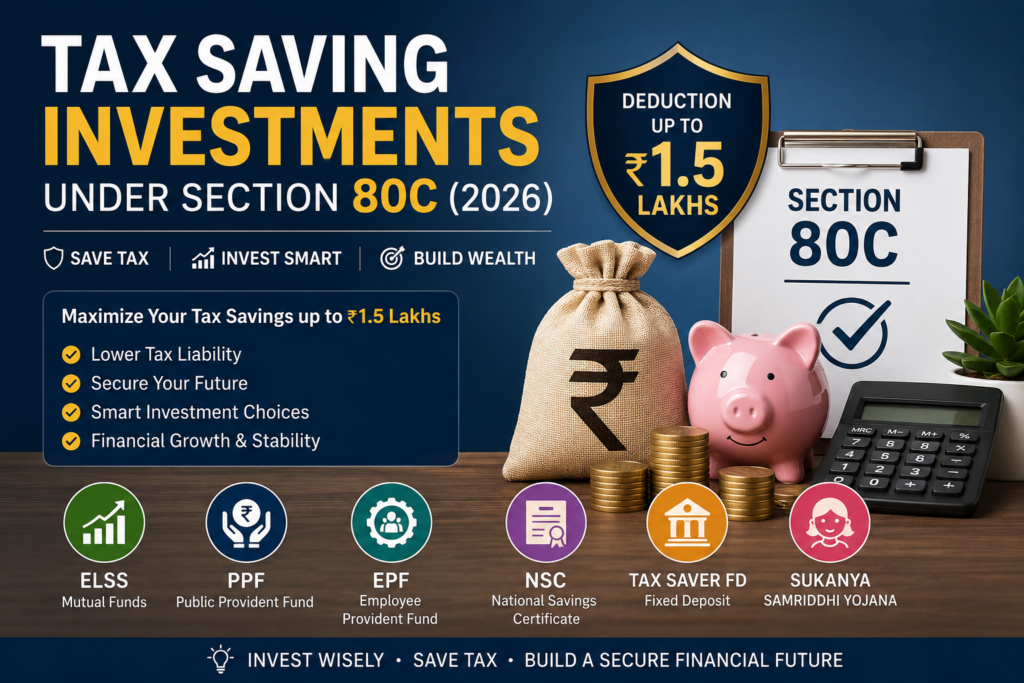
💰 Tax Saving Investments Under Section 80C (2026): Complete Guide to Save Income Tax
Tax planning is an important part of financial planning. In India, eligible taxpayers can use certain investments and expenses to claim deductions under Section 80C of the Income-tax Act, subject to applicable conditions and the tax regime selected.
Popular Section 80C options include ELSS, PPF, EPF, NSC, Tax Saver Fixed Deposits, and Sukanya Samriddhi Yojana. However, the best option depends on your financial goals, investment horizon, liquidity requirements, risk tolerance, and tax situation.
📖 Read Complete Guide
What is Section 80C?
Section 80C of the Income-tax Act provides a deduction for certain eligible investments, payments, and expenses, subject to the applicable rules. The commonly referenced overall deduction limit for Section 80C and specified related provisions is ₹1.5 lakh per financial year, subject to eligibility and the tax regime applicable to the taxpayer.
Taxpayers should not select an investment only because it offers a tax deduction. A good tax-saving strategy should also consider safety, returns, liquidity, lock-in period, and long-term financial goals.
Popular Tax Saving Investments Under Section 80C
| Investment | Risk | Typical Purpose |
|---|---|---|
| ELSS Mutual Funds | Market Linked | Tax Saving & Long-Term Growth |
| PPF | Relatively Low | Long-Term Savings |
| EPF | Relatively Low | Retirement Savings |
| NSC | Relatively Low | Medium-Term Savings |
| Tax Saver FD | Relatively Low | Fixed-Income Savings |
| Sukanya Samriddhi Yojana | Relatively Low | Girl Child’s Future |
1. ELSS Mutual Funds
Equity Linked Savings Scheme (ELSS) is a mutual fund category that invests primarily in equities and qualifies for eligible tax deduction under Section 80C, subject to applicable rules.
- 📈 Market-linked investment.
- ⏳ Has a 3-year lock-in period.
- 💰 Suitable for investors seeking long-term growth potential.
- ⚖️ Higher risk than traditional fixed-income tax-saving products.
ELSS may be considered by investors who have a long-term horizon and are comfortable with market fluctuations. Past returns are not guaranteed.
2. Public Provident Fund (PPF)
PPF is a government-backed long-term savings scheme suitable for investors looking for relatively stable, long-term savings. Contributions may qualify for applicable Section 80C deduction.
- 🛡️ Government-backed savings.
- 📅 Long-term investment horizon.
- 💰 Suitable for conservative investors.
- 🧾 Eligible tax benefits subject to prevailing rules.
3. Employees’ Provident Fund (EPF)
EPF is a retirement savings mechanism primarily available to eligible salaried employees. Employee contributions may qualify for tax deduction under applicable provisions.
- 👨💼 Mainly relevant for eligible salaried employees.
- 🏦 Designed for retirement savings.
- 💰 Encourages disciplined contributions.
- 🧾 Tax treatment is subject to prevailing rules and applicable conditions.
4. National Savings Certificate (NSC)
NSC is a government-backed small savings instrument available through India Post. It can be considered by investors seeking relatively stable medium-term savings and eligible tax benefits.
- 🏦 Government-backed investment.
- 📅 5-year maturity under the current framework.
- 🧾 Eligible investment may qualify for Section 80C deduction.
- 💰 Interest is accumulated according to scheme rules.
5. Tax Saver Fixed Deposit
A Tax Saver Fixed Deposit is a bank fixed deposit with a mandatory 5-year lock-in that may qualify for Section 80C deduction, subject to applicable rules.
- 🏦 Bank-based fixed-income investment.
- ⏳ 5-year lock-in.
- 💰 Fixed interest rate for the applicable deposit.
- 🧾 Eligible investment may qualify for tax deduction.
Investors should compare interest rates, bank terms, taxation of interest, and liquidity requirements before choosing a Tax Saver FD.
6. Sukanya Samriddhi Yojana
Sukanya Samriddhi Yojana is a government-backed savings scheme designed for an eligible girl child. Contributions can qualify for applicable tax benefits subject to prevailing rules.
- 👧 Designed for the financial future of a girl child.
- 🛡️ Government-backed savings structure.
- 🎓 Suitable for long-term education planning.
- 💰 Long-term disciplined savings.
Section 80C Investment Comparison
| Investment | Risk | Lock-in / Horizon | Suitable For |
|---|---|---|---|
| ELSS | High / Market Linked | 3 Years | Long-Term Growth |
| PPF | Low | Long Term | Safe Long-Term Savings |
| EPF | Low | Retirement Oriented | Salaried Employees |
| NSC | Low | 5 Years | Medium-Term Savings |
| Tax Saver FD | Low | 5 Years | Fixed-Income Investors |
| SSY | Low | Long Term | Girl Child’s Future |
How to Choose the Right Tax-Saving Investment?
- Check your tax regime: Determine whether the deduction is available under the tax regime applicable to you.
- Calculate existing deductions: EPF contributions and eligible payments may already use part of your available deduction limit.
- Identify your financial goal: Tax saving should not be separated from your broader financial plan.
- Consider your risk profile: ELSS carries market risk, while products such as PPF and NSC have a different risk-return profile.
- Check liquidity: Understand the lock-in period before investing.
- Compare post-tax returns: The tax treatment of returns can affect the actual outcome of an investment.
Common Tax-Saving Mistakes
- ❌ Investing only in March to save tax.
- ❌ Choosing an investment without understanding its lock-in period.
- ❌ Assuming all Section 80C investments have the same risk.
- ❌ Ignoring existing EPF and other eligible contributions.
- ❌ Investing without considering financial goals.
- ❌ Choosing an investment only because of the tax deduction.
Tax Saving Investment Checklist
| Checklist | Status |
|---|---|
| Tax Regime Checked | ☐ |
| Existing 80C Contributions Calculated | ☐ |
| Financial Goal Identified | ☐ |
| Risk Profile Considered | ☐ |
| Lock-in Period Checked | ☐ |
| Portfolio Diversification Reviewed | ☐ |
Frequently Asked Questions
Q1. What is the Section 80C deduction limit?
The commonly applicable combined limit for Section 80C and specified related provisions is ₹1.5 lakh per financial year, subject to eligibility and the applicable tax regime.
Q2. Which is better for tax saving: ELSS or PPF?
There is no single best option for everyone. ELSS is market-linked and may offer higher long-term growth potential with higher risk, while PPF is designed for relatively stable long-term savings. The choice should depend on your goals and risk profile.
Q3. Is Section 80C available under the new tax regime?
Most deductions under Section 80C are generally associated with the old tax regime. Taxpayers should check the latest applicable tax rules and determine which regime is beneficial for their circumstances.
Q4. Can EPF and ELSS both be included for tax planning?
Eligible EPF contributions and ELSS investments can both fall within the relevant tax deduction framework, but the overall applicable limit and tax regime should be considered.
Q5. Should I invest ₹1.5 lakh only to save tax?
No. Tax saving should be part of a broader financial plan. Invest only in products that are suitable for your financial goals, risk profile, liquidity needs, and investment horizon.
Key Takeaway
The best tax-saving strategy is not simply about saving tax. It is about choosing suitable investments that combine tax efficiency with your financial goals, risk profile, liquidity requirements, and long-term wealth creation plan.
Disclaimer: This article is for educational purposes only and should not be considered financial, tax, or investment advice. Tax laws, deduction limits, eligibility conditions, interest rates, and investment rules may change from time to time. Please verify the latest applicable tax rules before making any investment or tax-planning decision and consult a qualified tax or financial professional where appropriate.