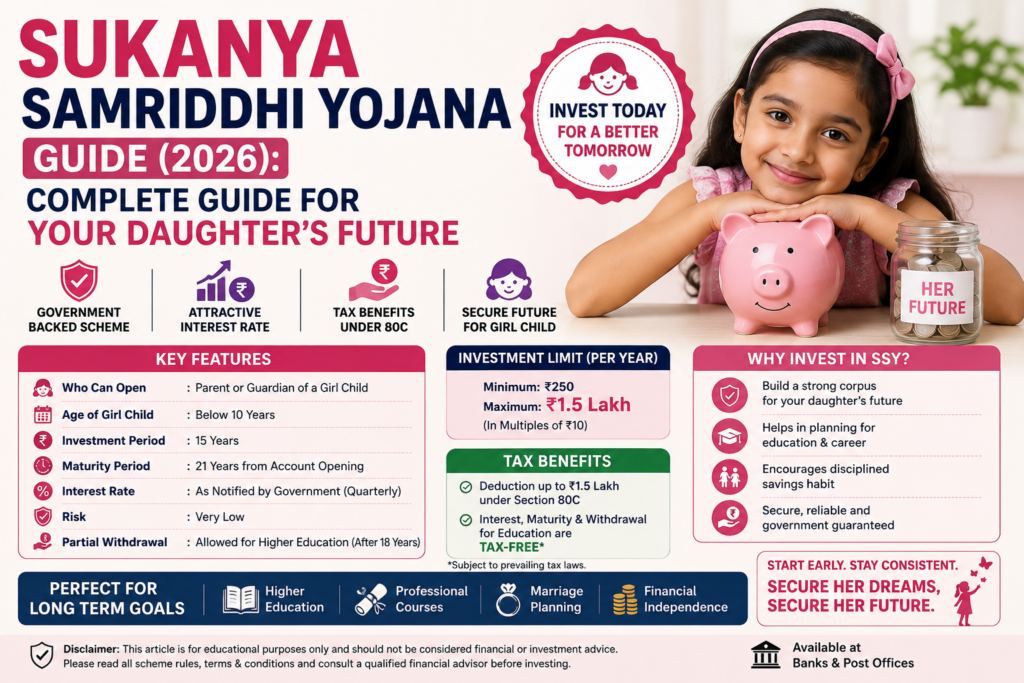
👧 Sukanya Samriddhi Yojana Guide (2026): Complete Guide for Your Daughter’s Future
Sukanya Samriddhi Yojana (SSY) is a government-backed savings scheme designed specifically for the financial future of a girl child. It can help parents and guardians build a dedicated corpus for important goals such as higher education and marriage.
The scheme combines disciplined long-term savings, government-declared interest, and tax benefits subject to applicable rules. This guide explains how Sukanya Samriddhi Yojana works, who can open an account, contribution rules, maturity, withdrawal provisions, tax benefits, and how it can fit into a child’s financial plan.
📖 Read Complete Guide
What is Sukanya Samriddhi Yojana?
Sukanya Samriddhi Yojana is a government-backed small savings scheme created to encourage parents and guardians to save for the financial needs of a girl child. It is primarily suitable for long-term goals such as education and marriage.
- 👧 Designed for a girl child.
- 🏦 Government-backed savings scheme.
- 💰 Encourages disciplined long-term savings.
- 📈 Interest is declared by the government periodically.
- 🎓 Useful for future education planning.
- 💍 Can support long-term marriage planning.
Key Features of Sukanya Samriddhi Yojana
| Feature | Details |
|---|---|
| Eligibility | Eligible girl child below the prescribed age limit |
| Account Holder | Parent or legal guardian on behalf of eligible girl child |
| Investment Period | Contributions generally required for 15 years |
| Maturity | Generally 21 years from account opening, subject to scheme rules |
| Risk | Very Low |
| Interest | Rate notified by the Government from time to time |
Who Can Open a Sukanya Samriddhi Account?
The account can generally be opened by a parent or legal guardian in the name of an eligible girl child, subject to the applicable SSY rules.
- 👧 The account is opened for an eligible girl child.
- 👨👩👧 Parent or legal guardian can operate the account as permitted.
- 📅 The account must be opened within the prescribed eligibility age.
- 🏦 Account can be opened through authorized banks and post offices.
How Much Can You Invest?
Sukanya Samriddhi Yojana allows parents and guardians to make regular contributions within the minimum and maximum limits prescribed under the scheme. The investment amount should be selected according to your budget and the child’s future financial goals.
- 💰 Minimum annual contribution: As prescribed under current SSY rules.
- 📈 Maximum annual contribution: As prescribed under current SSY rules.
- 📅 Contributions can be made regularly during the contribution period.
- 🎯 Consistent investing can help build a larger long-term corpus.
Major Benefits of Sukanya Samriddhi Yojana
- 🛡️ Government-backed savings.
- 👧 Dedicated investment for a girl’s future.
- 🎓 Suitable for education planning.
- 💰 Encourages disciplined savings.
- 📈 Benefits from long-term compounding.
- 🧾 Tax benefits may be available under applicable tax provisions.
Sukanya Samriddhi Yojana for Child Education Planning
One of the major purposes of SSY is to help parents create a dedicated corpus for their daughter’s future. Parents can combine SSY with other investments such as mutual funds, PPF, or other suitable financial products depending on their goals and risk profile.
Starting early gives parents more time to save and allows the investment to benefit from long-term compounding. The exact amount required should be calculated according to the expected education cost, inflation, and investment horizon.
SSY vs PPF vs Mutual Funds
| Investment | Risk | Main Purpose |
|---|---|---|
| Sukanya Samriddhi Yojana | Very Low | Girl Child’s Future |
| PPF | Very Low | Long-Term Savings |
| Equity Mutual Funds | Market Linked | Long-Term Wealth Creation |
How to Build a Child Education Investment Plan
- Set the education goal: Estimate the future cost of education.
- Calculate the time horizon: Determine how many years remain before the money is required.
- Start early: Early investing gives your money more time to compound.
- Diversify: Consider suitable investments according to your risk profile.
- Review regularly: Increase contributions as income and financial capacity grow.
Common Mistakes to Avoid
- ❌ Starting the child’s financial planning too late.
- ❌ Ignoring inflation while calculating education costs.
- ❌ Investing without a specific financial goal.
- ❌ Depending entirely on one investment product.
- ❌ Not reviewing the child’s financial plan periodically.
Frequently Asked Questions
Q1. Who is Sukanya Samriddhi Yojana meant for?
SSY is designed specifically for eligible girl children and is intended to help parents or guardians save for their future financial needs.
Q2. Is Sukanya Samriddhi Yojana safe?
It is a government-backed small savings scheme and is generally considered a low-risk savings option.
Q3. Can SSY be used for higher education?
Yes. Subject to applicable rules and conditions, withdrawals can be permitted for higher education purposes.
Q4. Can I invest in SSY and Mutual Funds together?
Yes. Parents may combine SSY with suitable mutual funds and other investments to create a diversified child education and financial plan.
Q5. Is SSY suitable for every financial goal?
SSY is specifically designed for the financial future of an eligible girl child. Other investment options may be required for goals with different time horizons or liquidity requirements.
Key Takeaway
Sukanya Samriddhi Yojana can be an important part of a girl’s long-term financial plan. Starting early, contributing consistently, and combining SSY with other suitable investments can help parents work towards education, marriage, and future financial goals.
Disclaimer: This article is for educational purposes only and should not be considered financial, tax, or investment advice. Sukanya Samriddhi Yojana interest rates, tax rules, eligibility conditions, withdrawal provisions, and other scheme rules may change from time to time. Please verify the latest government rules before investing and consult a qualified financial advisor for personalized financial planning.