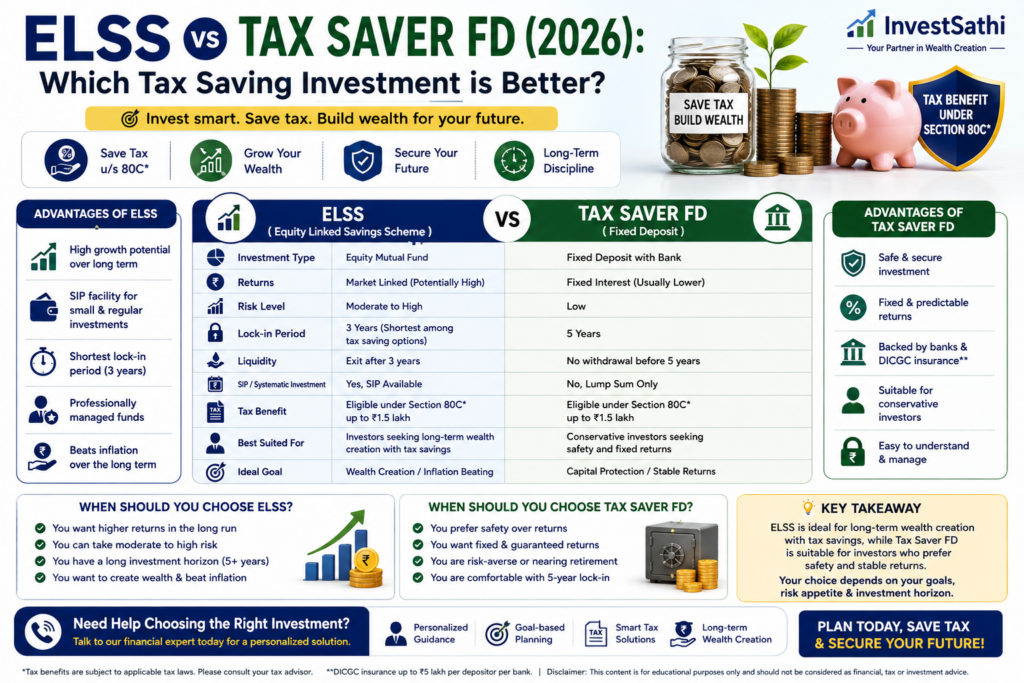
🏦 ELSS vs Tax Saver FD (2026): Which Tax Saving Investment is Better?
ELSS (Equity Linked Savings Scheme) and Tax Saver Fixed Deposits (FDs) are two popular tax-saving investment options available in India. Both can help eligible investors claim tax benefits under applicable tax laws, but they differ significantly in terms of returns, risk, liquidity, lock-in period, and wealth creation potential.
If you are confused about whether to invest in ELSS or a Tax Saver FD, this guide compares both options to help you choose the investment that best matches your financial goals, investment horizon, and risk tolerance.
📖 Read Complete Guide
What is ELSS?
ELSS (Equity Linked Savings Scheme) is an equity mutual fund that primarily invests in stocks. It is designed for long-term wealth creation and offers tax-saving benefits under applicable tax provisions.
- ✅ Equity-oriented mutual fund.
- ✅ Market-linked returns.
- ✅ 3-year lock-in period.
- ✅ Suitable for long-term wealth creation.
What is a Tax Saver FD?
A Tax Saver Fixed Deposit is a bank fixed deposit with a mandatory 5-year lock-in period. It offers fixed interest rates and is generally preferred by conservative investors seeking stable returns and capital protection.
- ✅ Bank fixed deposit.
- ✅ Fixed interest rate.
- ✅ 5-year lock-in period.
- ✅ Suitable for conservative investors.
ELSS vs Tax Saver FD Comparison
| Feature | ELSS | Tax Saver FD |
|---|---|---|
| Investment Type | Equity Mutual Fund | Fixed Deposit |
| Returns | Market Linked | Fixed Interest |
| Risk Level | Moderate to High | Low |
| Lock-in Period | 3 Years | 5 Years |
| Suitable For | Long-Term Wealth Creation | Capital Protection |
When Should You Choose ELSS?
- 📈 You want long-term wealth creation.
- 💰 You can tolerate market fluctuations.
- 📅 You prefer a shorter lock-in period.
- 🎯 Your goal is long-term capital appreciation.
When Should You Choose Tax Saver FD?
- 🛡️ You prefer fixed and predictable returns.
- 🏦 Capital safety is your priority.
- 👴 You have a conservative risk profile.
- 📅 You are comfortable with a 5-year lock-in.
Advantages of ELSS
- ✅ Shortest lock-in among tax-saving investments.
- ✅ SIP investment option.
- ✅ Potential for long-term wealth creation.
- ✅ Professionally managed portfolio.
Advantages of Tax Saver FD
- ✅ Fixed and predictable returns.
- ✅ Lower investment risk.
- ✅ Easy to understand and manage.
- ✅ Suitable for conservative investors.
Frequently Asked Questions
Q1. Which is better—ELSS or Tax Saver FD?
It depends on your financial goals. ELSS is generally suitable for long-term wealth creation, while Tax Saver FD is preferred by investors looking for capital protection and stable returns.
Q2. Which has a shorter lock-in period?
ELSS has a 3-year lock-in period, whereas Tax Saver Fixed Deposits have a mandatory 5-year lock-in period.
Q3. Can I invest in both ELSS and Tax Saver FD?
Yes. Many investors include both in their financial plan to balance growth potential and stability, depending on their investment objectives and tax planning needs.
Key Takeaway
ELSS is designed for investors seeking long-term wealth creation through equity markets, while Tax Saver Fixed Deposits are suitable for those who prefer stable, predictable returns with lower risk. Choose the option that best aligns with your financial goals, investment horizon, and risk tolerance.
Disclaimer: This article is for educational purposes only and should not be considered financial, tax, or investment advice. Tax laws and investment returns may change over time. Please consult a qualified financial advisor before making investment decisions.