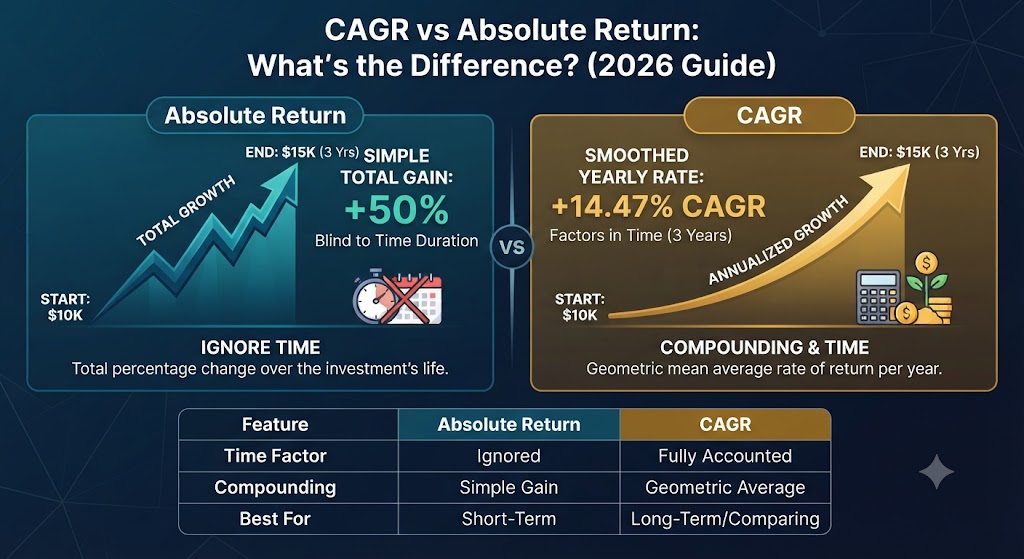
📈 CAGR vs Absolute Return: What’s the Difference? (2026 Guide)
When evaluating mutual fund performance, investors often come across two commonly used return metrics—Absolute Return and CAGR (Compound Annual Growth Rate). While both measure investment performance, they serve different purposes and can lead to different conclusions if interpreted incorrectly.
Understanding the difference between CAGR and Absolute Return helps investors compare mutual funds more accurately and make better long-term investment decisions.
📖 Read Complete Guide
What is Absolute Return?
Absolute Return measures the total percentage gain or loss on an investment from the purchase date to the current or redemption date without considering the investment period.
Absolute Return Formula
Absolute Return = ((Current Value − Investment Value) ÷ Investment Value) × 100
Example:
- Investment = ₹1,00,000
- Current Value = ₹1,30,000
- Absolute Return = 30%
What is CAGR?
CAGR (Compound Annual Growth Rate) represents the average annual growth rate of an investment over multiple years, assuming profits are reinvested each year.
CAGR Formula
CAGR = [(Ending Value ÷ Beginning Value)1/n − 1] × 100
Example:
- Investment = ₹1,00,000
- Current Value after 5 Years = ₹1,61,051
- CAGR = 10% per year
CAGR vs Absolute Return
| Feature | Absolute Return | CAGR |
|---|---|---|
| Time Considered | No | Yes |
| Suitable For | Less than 1 Year | More than 1 Year |
| Compounding Effect | Ignored | Included |
| Best Used For | Short-Term Performance | Long-Term Performance |
When Should You Use Absolute Return?
- ✅ Investments held for less than one year.
- ✅ Short-term mutual fund performance.
- ✅ Comparing recent returns.
- ✅ Liquid and ultra-short-term funds.
When Should You Use CAGR?
- ✅ Investments held for more than one year.
- ✅ Long-term SIP or lump sum investments.
- ✅ Retirement planning.
- ✅ Comparing equity mutual funds.
- ✅ Wealth creation analysis.
Illustration
| Investment | Value |
|---|---|
| Initial Investment | ₹1,00,000 |
| Value After 5 Years | ₹1,61,051 |
| Absolute Return | 61.05% |
| CAGR | 10% per year |
Common Mistakes Investors Make
- ❌ Comparing long-term funds using Absolute Return.
- ❌ Ignoring compounding.
- ❌ Assuming higher Absolute Return always means better performance.
- ❌ Comparing investments with different holding periods.
- ❌ Ignoring XIRR for SIP investments.
Frequently Asked Questions (FAQs)
Q1. Which is better—CAGR or Absolute Return?
Neither is universally better. Absolute Return is useful for investments held for less than one year, while CAGR is generally more suitable for investments held over multiple years.
Q2. Is CAGR applicable to SIP?
No. Since SIP investments occur on different dates, XIRR is generally considered a more appropriate measure than CAGR.
Q3. Why is CAGR preferred for long-term investments?
Because it reflects the annualized growth rate while taking the compounding effect into account.
Q4. Can two investments have the same Absolute Return but different CAGR?
Yes. If the investments were held for different periods, their CAGR can differ even if the total return is the same.
Key Takeaway
Use Absolute Return to evaluate short-term investments and CAGR to measure long-term investment performance. Choosing the right return metric helps you compare mutual funds more accurately and make better investment decisions.
Disclaimer: This article is for educational purposes only and should not be considered financial or investment advice. Mutual fund investments are subject to market risks. Please read all scheme-related documents carefully before investing and consult a qualified financial advisor before making investment decisions.