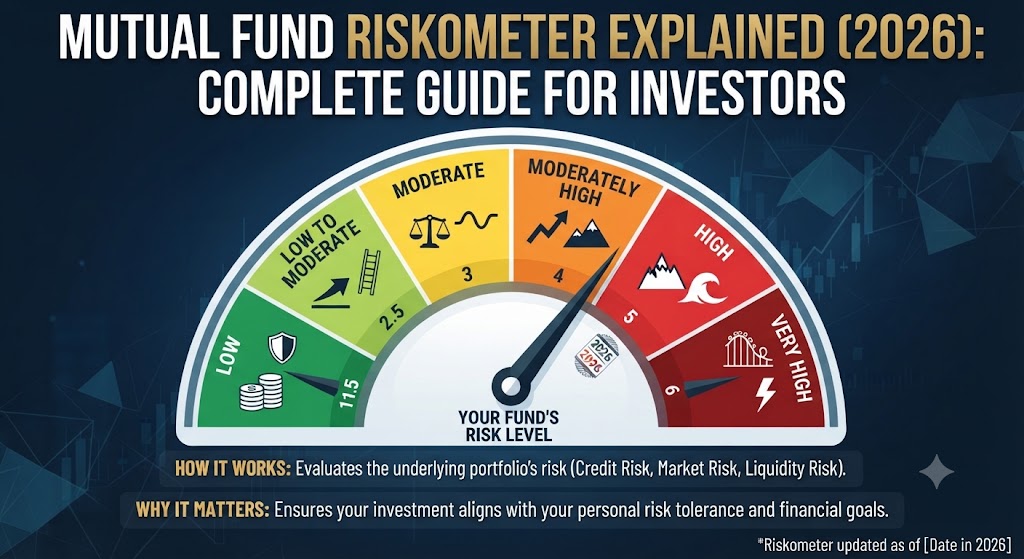
⚖️ Mutual Fund Riskometer Explained (2026): Complete Guide for Investors
Before investing in any mutual fund, one of the most important things to check is its Riskometer. Every mutual fund in India displays a Riskometer to help investors understand the level of risk associated with the scheme.
Many first-time investors ignore the Riskometer and choose funds based only on past returns. However, understanding the Riskometer can help you select investments that match your financial goals and risk tolerance.
📖 Read Complete Guide
What is a Mutual Fund Riskometer?
A Mutual Fund Riskometer is a standardized risk indicator that shows the overall risk level of a mutual fund scheme. It helps investors understand how much investment risk they may be taking before investing.
Why is the Riskometer Important?
- ✅ Helps investors understand investment risk.
- ✅ Assists in selecting funds suitable for individual risk appetite.
- ✅ Encourages informed investment decisions.
- ✅ Makes it easier to compare different mutual fund schemes.
- ✅ Supports better long-term financial planning.
Riskometer Levels Explained
| Risk Level | Suitable For | Typical Investment Type |
|---|---|---|
| Low Risk | Conservative Investors | Liquid & Overnight Funds |
| Low to Moderate | Short-Term Investors | Ultra Short Duration Funds |
| Moderate | Balanced Investors | Hybrid Funds |
| Moderately High | Long-Term Investors | Large Cap & Flexi Cap Funds |
| High | Aggressive Investors | Mid Cap Funds |
| Very High | Experienced Investors | Small Cap & Sectoral Funds |
How is the Riskometer Determined?
The Riskometer is based on various factors such as:
- 📈 Asset allocation of the scheme.
- 📊 Volatility of underlying securities.
- 🏦 Credit quality (for debt funds).
- ⏳ Interest rate sensitivity.
- 🌍 Market capitalization and diversification.
Risk Level by Mutual Fund Category
| Fund Category | Typical Risk Level |
|---|---|
| Liquid Funds | Low |
| Short Duration Funds | Low to Moderate |
| Balanced Advantage Funds | Moderate |
| Large Cap Funds | Moderately High |
| Flexi Cap Funds | Moderately High |
| Mid Cap Funds | High |
| Small Cap Funds | Very High |
Common Mistakes Investors Make
- ❌ Ignoring the Riskometer before investing.
- ❌ Choosing funds only based on recent returns.
- ❌ Investing in high-risk funds despite low risk tolerance.
- ❌ Assuming higher risk always guarantees higher returns.
- ❌ Not reviewing changes in the Riskometer periodically.
Tips for Using the Riskometer
- ✔ Match the risk level with your financial goals.
- ✔ Consider your investment horizon.
- ✔ Review the Riskometer whenever you invest in a new scheme.
- ✔ Diversify your portfolio across suitable risk categories.
- ✔ Consult a financial advisor if unsure.
Frequently Asked Questions (FAQs)
Q1. Is a Very High Risk fund always bad?
No. A Very High Risk fund may be suitable for investors with a long investment horizon and a higher risk tolerance, but it also carries greater potential volatility.
Q2. Can the Riskometer change?
Yes. The risk level of a mutual fund can change over time if the underlying portfolio or market conditions change.
Q3. Should beginners invest in High Risk funds?
Beginners should first assess their financial goals and risk tolerance. High-risk funds may not be suitable for everyone.
Q4. Is Riskometer the only factor to consider?
No. Investors should also evaluate investment objectives, asset allocation, fund performance consistency, expense ratio, and investment horizon.
Key Takeaway
The Mutual Fund Riskometer is a valuable tool that helps investors understand the potential risk of a scheme before investing. Always choose mutual funds that align with your financial goals, investment horizon, and personal risk tolerance rather than focusing only on returns.
Disclaimer: This article is for educational purposes only and should not be considered financial or investment advice. Mutual fund investments are subject to market risks. Please read all scheme-related documents carefully before investing and consult a qualified financial advisor before making investment decisions.